Mystery games for 2 players: choosing a game for two
For mystery games for two players, choose a game where both people solve the clues together. Blackbrim: 1876 offers detective work in a Victorian town. The Fifth Column is a wartime thriller with codes to crack, and Down the Rabbit Hole is a gentler Wonderland escape. All three play with 1 to 6 people. The differences are in the setting, puzzle difficulty and time you want to spend.
Two players can share a cipher or logic grid comfortably, though a large set of documents takes longer to read between two people. Here’s how to divide the work and choose a box that suits your evening.
How a game for 1 to 6 players works with two
Our games support solo play and groups of up to six. In our puzzle design guide, we discuss how separate materials help a group share the work. A pair has more room to examine everything together, or can split up and compare discoveries.
With two people, it’s easy to switch between reading, writing and checking an idea. If one person has taken over, swap jobs at the next puzzle so both stay involved.
The puzzle types that get better with two people
Our escape room puzzle types guide groups puzzles by what they ask you to do. The table below shows how common versions can feel with a pair or a larger group. These are planning judgments; the details of an individual puzzle matter more than its category.
| Puzzle type | With six at one table | With two |
|---|---|---|
| Ciphers and codes | One person may do most decoding | Easy to split reading and writing |
| Logic and deduction | A single grid can be hard to share | One person can check the other |
| Hidden and revealed | A small reveal can be hard to see | Both can watch closely |
| Pattern and mapping | Several perspectives can help | Room to compare two approaches |
| Physical and mechanical | More hands for larger assemblies | Both can handle pieces |
| Word and language | More vocabulary and ideas | Depends on language preferences |
| Search and observation | More people can look at once | Allow time to inspect materials |
| Information across several documents | Reading can be divided | More reading per person |
Ciphers are easy to split between two people. One reads symbols while the other writes letters, or you each decode part of a message and compare the result. Swap jobs if one person is doing most of the work.
A logic grid can also suit a pair. One person keeps the grid while the other reads the clues and checks deductions. Both can see how the answer develops without needing duplicate notes.
A mirror message or translucent overlay gives a pair a close view of the reveal. In a larger group, make sure everyone can see before moving on. The number of people who can handle the piece at once matters more than the total player count.

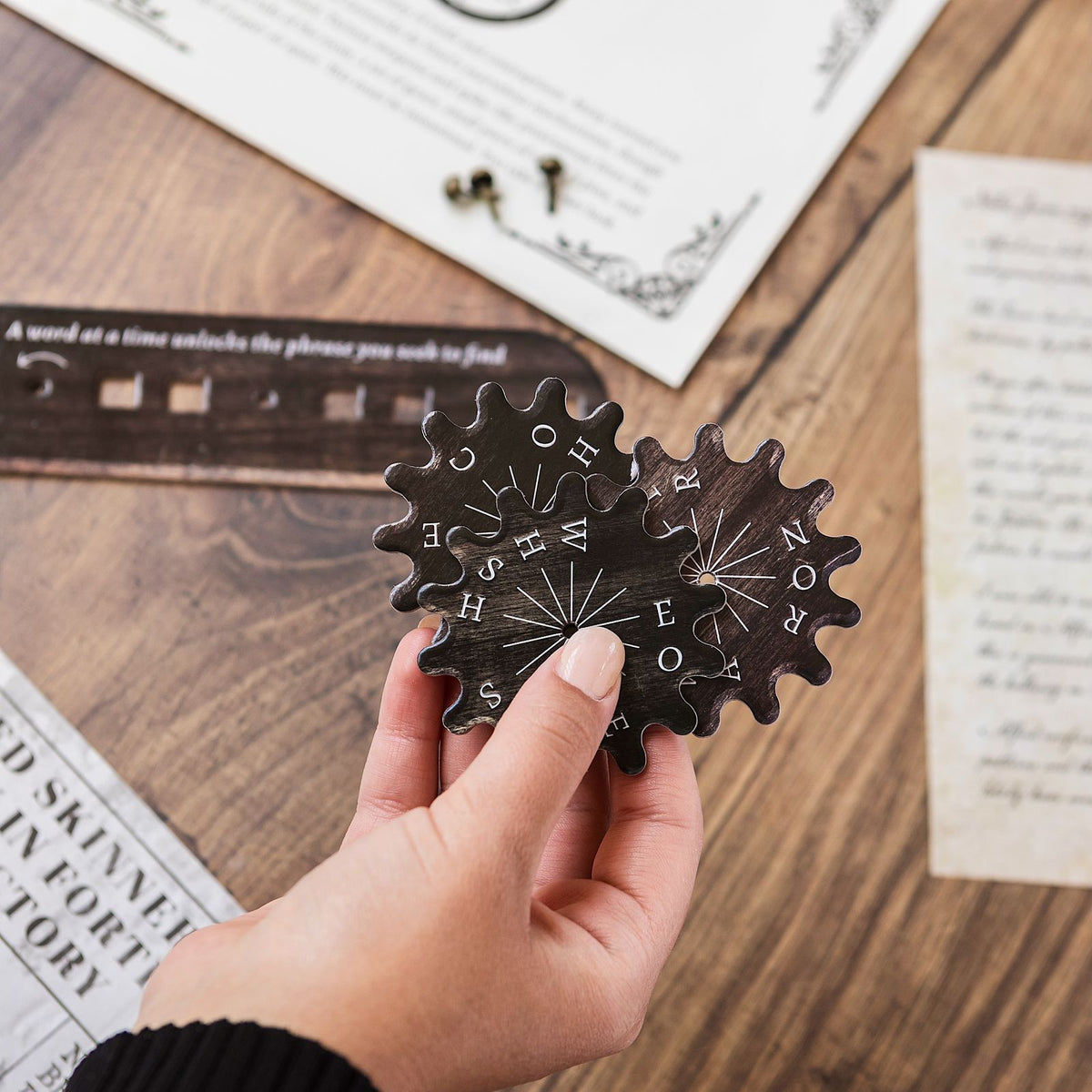
Pattern puzzles give you a chance to compare ideas. The disc above is from Down the Rabbit Hole, with hours around the outside and two rings of letters inside. One person can turn it while the other reads the related card.
What two players give up
A pair has fewer people to share the reading and searching. Plan for that when you divide the materials.
A larger group can inspect more materials at once. With two people, leave time to look carefully and compare what you notice. You may enjoy that slower pace.
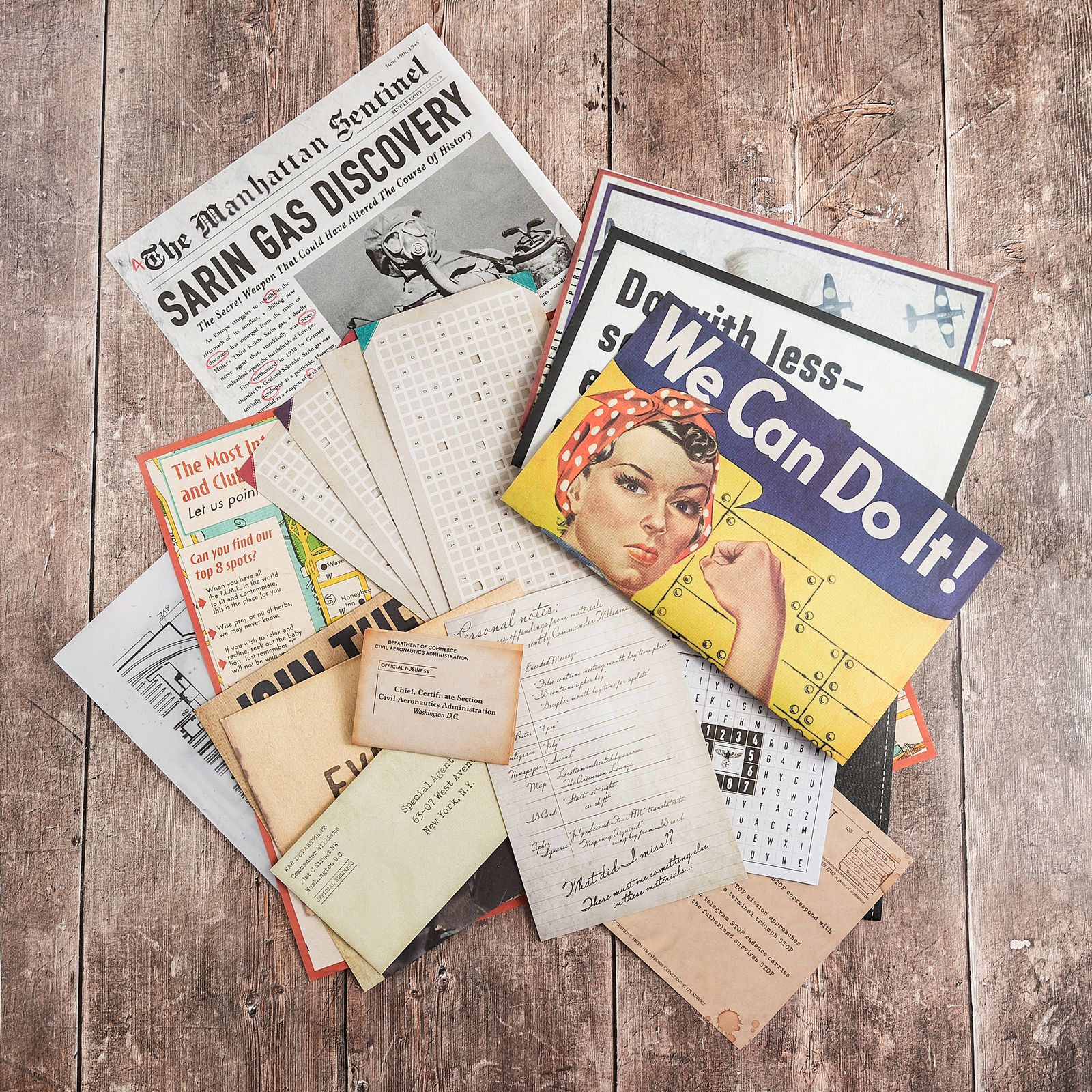
A document-heavy section means more reading for each person in a pair. Split the papers at the start, then share names, dates or patterns that might connect. Read each other’s pages when a detail seems relevant, rather than assuming both of you need to read everything before beginning.
How much time should two players allow?
Most of our two-part games are estimated at 2 to 4+ hours. A pair might finish within that range or take longer, depending on experience and how often you use hints. Leave some room in your plans, especially for a first game.
Whether that is a problem depends entirely on your evening. Yanira, who played Blackbrim: 1876, described the shape of it:
My hubby and I played this as a date night. We took several days in a two week span to play. Great way to spend time together!
Most of our boxed games contain two parts, so there’s a natural place to stop halfway. You can also pause during a part and return later. If you only have ninety minutes, choose a shorter game rather than counting on a two-part box fitting the slot. Our date night games guide has more ideas, including how to play when one person solves faster.
Use the companion guide when you want help. Hints come in stages, so you can take a small nudge before looking further. There’s no timer, and taking a break is an option whenever the game starts to feel like work.
Try the puzzle types before you buy
Try a puzzle together in our free Puzzle Archive before choosing a box. It has fifteen browser puzzles with optional hints and answer checking. For paper puzzles, see the separate free printable escape room puzzles guide.
Our picks for two players
All of these games support 1 to 6 players, including a pair. Choose by the story and how much time you want to spend. You can compare the other settings in our full game collection.
The Fifth Column, our pick for two
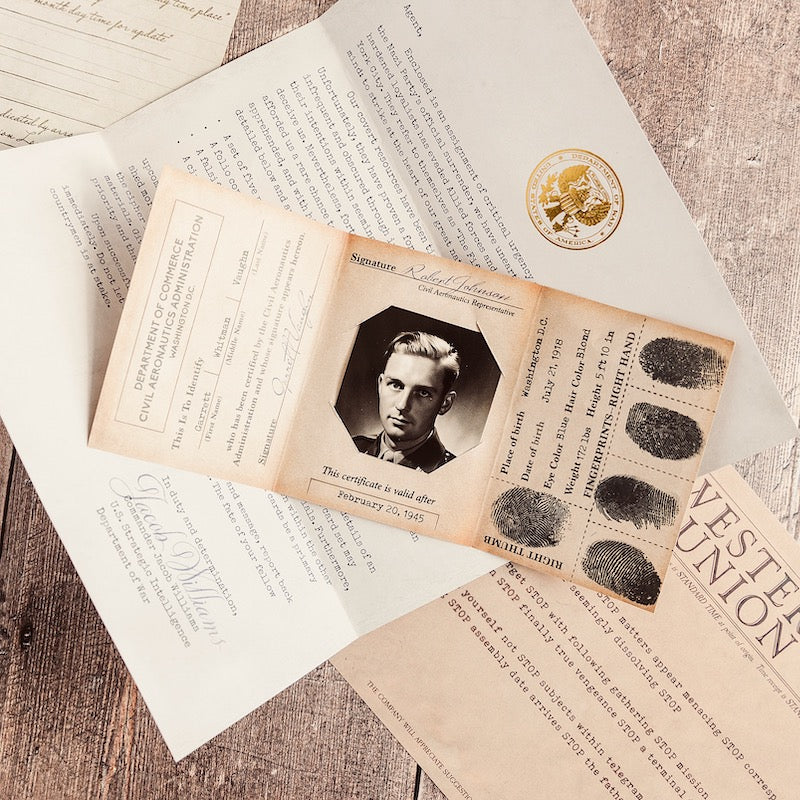
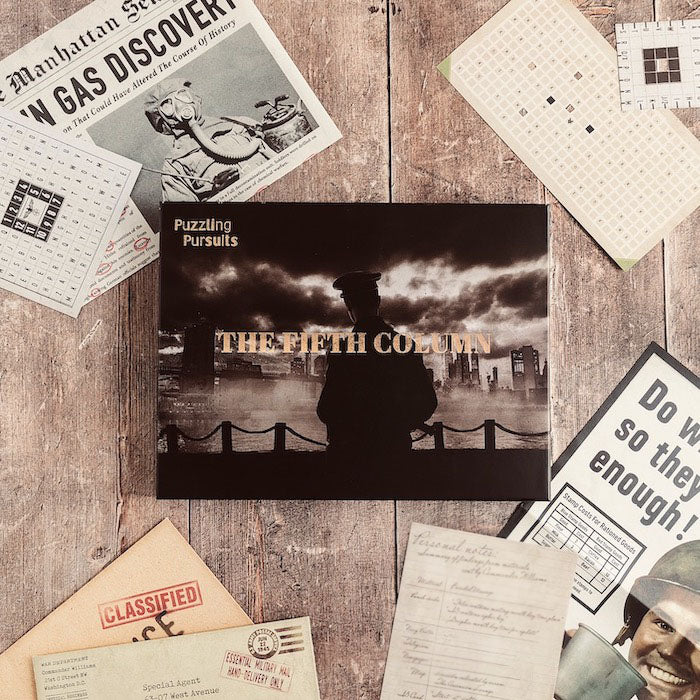
The Fifth Column takes you to Manhattan in June 1945, where a Nazi plot continues after Germany’s surrender. Choose it if you’d enjoy a wartime story and a longer codebreaking evening.
It plays with 1 to 6 people, is rated 14+, and takes 2 to 4+ hours across two parts. It has 4.9 stars from 152 reviews. Luke described playing as a pair:
Such a blast, and much more difficult than one would think. My girlfriend turned out to be a much better codebreaker than me! This was much easier playing with another person, I couldn't imagine doing it alone.
See how The Fifth Column works, with 4.9 stars from 152 reviews.
Down the Rabbit Hole, if you have one evening
Down the Rabbit Hole takes you through Wonderland as you look for a way out. It’s our gentlest boxed game and has one part, so it’s a useful choice for a first evening together.
It plays with 1 to 6 people, is rated 12+, and takes 1.5 to 3+ hours. It has 4.9 stars from 82 reviews. Leave room to take a break or continue another day if you want to.
Blackbrim: 1876, if you want detective work
Blackbrim: 1876 makes you a private detective in Victorian England, following the criminal Reager Skinner. The map and documents give the two of you plenty to examine and compare.
Blackbrim plays with 1 to 6 people, is rated 14+, and takes 2 to 4+ hours across two parts. It has 4.8 stars from 524 reviews. Forrest described playing with one other person:
Very fun game with a good variety of puzzles that kept us engaged for hours. Was a bit challenging with only two people but that didn't stop us from solving the puzzle.
If you would rather have two boxes
Blackbrim and The Fifth Column each contain a two-part story. You can play them over several evenings. The Synapse and Down the Rabbit Hole bundle pairs science fiction with Wonderland; for someone playing both games, use Synapse’s 14+ age rating. Keep the pieces intact and together so another person can play after you finish.
A shorter option for a single evening
For a standalone puzzle night, consider EXIT: The Game. The Secret Lab is rated 12+, and the series offers other settings and difficulty levels. Check the specific box’s player count and estimated playtime before buying.
Standard EXIT games may require folding, marking or cutting the components and are sold as single-use experiences. If you’d like to pass a finished game on, our boxed puzzles require no cutting or writing on the materials; keep them intact and repack them for the next player.
For the rest of the category, including the subscription boxes and the case-file games, we compared eleven of them in our guide to mystery box games for solo and small-group play.
Common questions
These details help when you’re choosing a game for two.
Do escape room games made for 6 players work with only 2?
Yes, if two players fall within the game’s supported range. Our games are for 1 to 6 players. A pair can share decoding and logic work, while a larger group may get through a set of documents faster.
How long does a two player escape room game take?
Most of our two-part games take 2 to 4+ hours. A pair may take longer depending on experience and hints, but that isn’t guaranteed. You can pause during play or between the two parts.
Which puzzle types work best for two players?
Ciphers and logic grids are easy to share between a reader and a checker. Physical puzzles and patterns can work well too. With several documents, split the reading and compare what you find.
What is the best mystery box for a date night?
The Fifth Column is a good option for a pair who wants a wartime thriller with codebreaking. It takes 2 to 4+ hours across two parts and has 4.9 stars from 152 reviews. For detective work, choose Blackbrim: 1876; for a gentler escape, try Down the Rabbit Hole.
Is a game harder with two players than with a group?
It depends on the players and the puzzles. Two people have more material to read each, while a larger group brings more perspectives. The puzzles stay the same, and optional hints are available if you need them.