10 free printable escape room puzzles
These ten escape room puzzles are free to print, one page each, and they run from introductory to expert. Solve them with a pencil, then check your answer online when you think you have it. You do not need an account, and you do not need to give us an email address to download them.
Download all ten as a single PDF, eleven pages including a cover sheet, or take them one at a time from the lists below.

These puzzles also appear in our online Puzzle Archive. Start with the introductory three if you are new to codes and ciphers. The stories were written for adults, so read each setup before sharing it with a younger solver.
How hard are these printable puzzles?
Every puzzle carries a star rating, marked on each one below and on the sheet itself.
Use the star ratings as a starting point: one star is introductory, two is intermediate, three is advanced and four is expert. Begin with the introductory set if you are new to these puzzles, then move up when you want more to work through.
A good answer should make sense when you find it. The online checker is there to confirm your solution, and the hints can help if you reach a dead end.
Three printable puzzles to start with
Start here if you have not done this kind of thing before, or if you are handing a puzzle to somebody who has not. Each one is a single mechanism, clearly signposted.
- Jungle Pet (✦, cipher). A special operations team reaches a ransacked island laboratory and has to work out what the missing scientists left behind. Jungle Pet hints and solution.
- Rendezvous (✦, acrostic). A pigeon taps at your window carrying a note. The meeting place is already set, and the timing is what you have to pull out of the poem. Rendezvous hints and solution.
- Defector (✦, anagram). One door stands between you and a rogue scientist's biolab, after three years and thousands of hours of CIA work. Defector hints and solution.
Rendezvous and Defector each have two hints available if you need a nudge.
Five printable puzzles for a group
The five intermediate puzzles are the ones we would put in front of a group, because most of them reward more than one person looking at the same sheet of paper.
- The Guardians (✦✦, knights and knaves logic). Two armored knights hold scrolls. Each scroll holds either only truths or only lies, and working out which one is which comes before the clues are worth anything. The Guardians hints and solution.
- Train Treason (✦✦, wordplay). A KGB agent is somewhere in the crowd coming off a train, and your instincts are not narrowing it down. Train Treason hints and solution.
- Conquest (✦✦, Caesar cipher). A messenger reaches the command tent with a wax tablet, and Caesar has to choose between disbanding his army and crossing the Rubicon. Conquest hints and solution.
- Bird Brain (✦✦, pattern recognition). Your colleague Norman is convinced his crows are talking to him. They stand upright or bend over, they face left or right, and they fall into four groups. Bird Brain hints and solution.
- Museum Mischief (✦✦, letter indexing). Four postcards carry nothing but innocuous travel scribble, and one of them tells you where an international museum thief will turn up next. Museum Mischief hints and solution.
Conquest is a useful introduction to Caesar ciphers. Trying a shift gives you something concrete to check: does the result read like English, or do you need to try another?
Two printable logic puzzles for experienced solvers
These two puzzles combine several steps. Set aside enough time to follow the clues without rushing.
- Bombs Away (✦✦✦, multi-cipher). In the story, you have ten minutes to stop the device. The device in front of you carries a transponder suggesting more of them are hidden inside a nearby opera house, and encrypted texts keep arriving on your phone. Bombs Away hints and solution.
- A Cooking Quandary (✦✦✦✦, logic scheduling). It is almost noon on Thanksgiving, dinner is at five, and you were supposed to be helping Aunt Edna and Uncle Earl hours ago. A Cooking Quandary hints and solution.
A Cooking Quandary is the hardest thing in the archive and the numbers are why. Six dishes, four of which need the oven, and the oven takes one dish at a time. Add up the oven time and it comes to four and a half hours inside a five hour window, so there are thirty spare minutes in the entire afternoon and every decision has to be made around them. Then, once you have the order right, the order itself becomes the input to a second puzzle.
Why the answers are not printed on the page
The hints and solutions are online so you can choose how much help to reveal.
With the answer printed at the bottom, it is easy to see more than you meant to. The online hints let you take a nudge and return to the puzzle while there is still something to work out.
Each puzzle has a series of hints, followed by a full solution. The number varies: Rendezvous has two, while A Cooking Quandary has eight to help with its longer chain of decisions. Start with one and see whether it gives you enough to continue.
Past the last hint there is a written solution if you want to stop. Type the right answer into the box instead and you get the end of the story along with a note on how the puzzle works.
What makes a puzzle satisfying?
Finding the answer should feel earned. A puzzle needs enough information to solve it, and the result should fit the clues well enough that you can explain how you got there.
Two things can spoil that moment: finding the answer by accident, or reaching it without understanding why it is right. We discuss both in what makes a good escape room puzzle. For more ideas to try, the eight families of escape room puzzle explains the different mechanisms.
What to do with them
Solve a sheet on your own, share one with a friend, or print a few for a gathering.
Hand one to a table of people who have not met
Print four copies of one intermediate puzzle and give a copy to each small group. It gives people something to discuss while they get to know each other. It also works on a long car trip, where a pencil is the only equipment. The same trick works on a family holiday, and we put it to use in our guide to Thanksgiving games for adults and kids, where the problem is a table with a forty-year age range around it.
Use them to work out whether a boxed game is for you
Print Conquest and Museum Mischief and try them with the people you would play a boxed game with. If you enjoy comparing ideas and working through the clues, you have a good starting point for choosing a longer adventure.
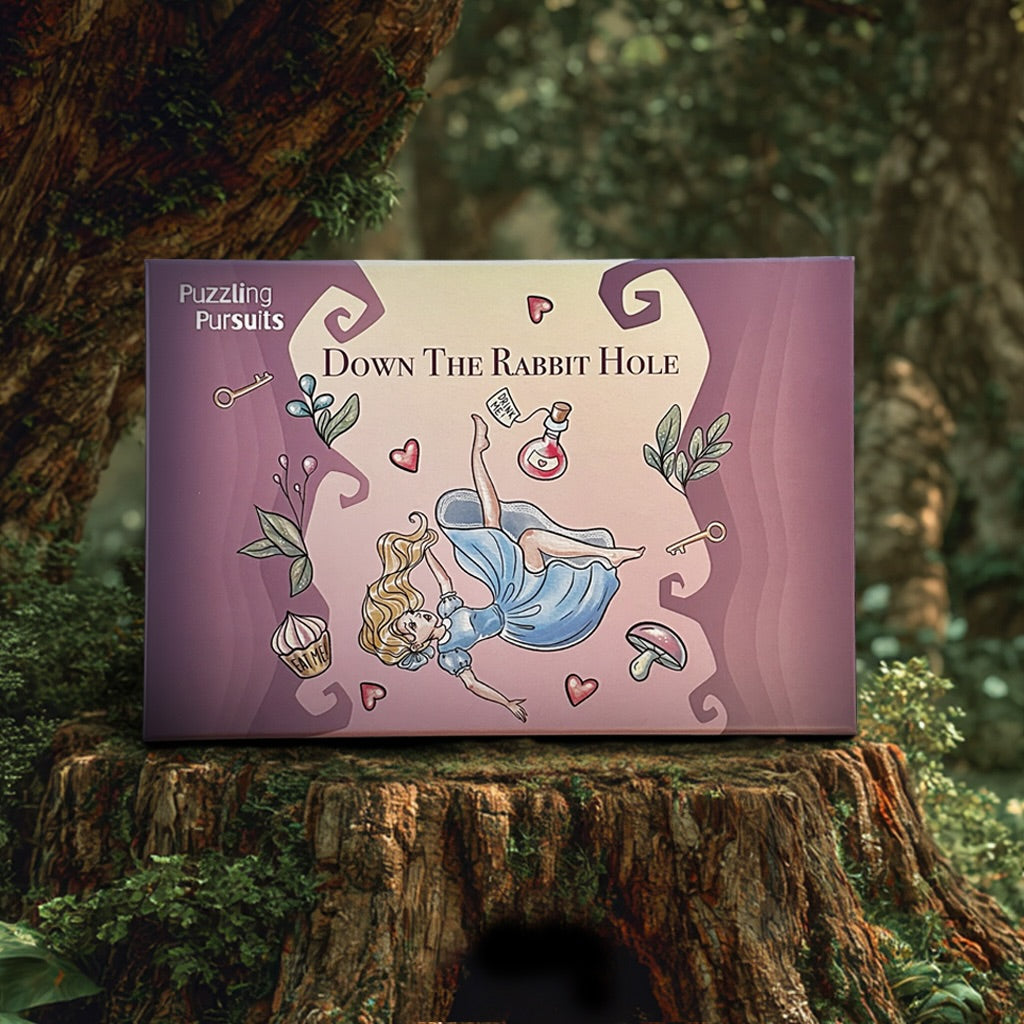
If it goes well, see how The Fifth Column works. You play a codebreaker in Manhattan in June 1945, trying to stop a Nazi plot after Germany's surrender. It has 2 to 4+ hours of play across two parts for 1 to 6 players aged 14+. Nothing in the box needs cutting or writing on, so you can pass the finished game to someone else. If a 1945 thriller is not your thing, the rest of our at-home escape room games include a Victorian detective case and a trip through Wonderland.
To see how the format compares with the rest of the category, our rundown of eleven mystery box games lists playtimes, player counts and what you actually do in each one.
Common questions
Are these really free?
Yes. You click the link and the PDF downloads, with no form in the way. The hints and solutions are open on our site as well.
What do I need to print them?
Any printer and ordinary paper. Each puzzle is a single US Letter page. Most print fine in black and white, though a few read better in color because the artwork carries part of the puzzle.
How long does one take?
There is no fixed play time. It depends on the puzzle's difficulty and whether you have used that kind of code or logic before. Start with a one-star puzzle, and use the hints whenever you want help.
Are these suitable for kids?
The introductory puzzles may suit younger players with adult help. Read the story first: some involve spies, a bomb or a biolab, though there is no graphic content. Our boxed games are rated 14+, except Down the Rabbit Hole at 12+.
Can I use these in a classroom or at a work event?
Please do, and print as many copies as you need. We only ask that you leave the page as it is rather than stripping our name off it, and that you point people at the site rather than handing out the solutions yourself.
Are there more than ten?
Ten puzzles are available to print here. All fifteen can be played in our free online Puzzle Archive, with hints and an answer checker.