Escape room puzzle types: 8 ways to build a game
Escape room puzzles often use ciphers, hidden messages, observation, patterns, logic, physical pieces, wordplay or information spread across documents. This guide groups them into eight useful types, with examples and advice for using each in a home game. Start with the number of people playing and the tools you have, then mix types so the evening asks for more than one kind of thinking.
The categories overlap: a decoder wheel can be both a cipher and a physical puzzle. Use them to plan variety, rather than as a fixed classification system.
For the broader design principles, see our guide to making a good escape room puzzle. For a practical build, the DIY escape room guide walks through setting up a game at home.
How the types compare
The table gives practical ways to share and check common versions of each puzzle type. The details depend on the materials you make and the information you supply.
A small lock and a large floor puzzle are both physical puzzles, but they give a group different ways to contribute. Plan around the actual piece in front of the players.
| Puzzle type | Ways to share the work | How to check the answer | Information to supply |
|---|---|---|---|
| Ciphers and codes | Share reading and checking, or use short related messages | Readable text can confirm the approach; check it fits the task | Supply the key or enough clues to identify it |
| Hidden and revealed | Let players compare the tool and the hidden material | Check that the revealed message clearly answers the task | Provide any tool and a clue to how it is used |
| Search and observation | Give people several pictures or a defined area to examine | Define what should be counted or found | Explain the search area and relevant details |
| Pattern and mapping | Share the pattern, key and possible connections | Test for alternative readings that give plausible answers | Explain unfamiliar symbols or conventions |
| Logic and deduction | Distribute statements and compare deductions | Make sure one answer satisfies all the clues | State every constraint needed for the solve |
| Physical and mechanical | Use pieces large enough to handle or examine together | A fit or opened mechanism may confirm the step | Plan for vision, movement and handling needs |
| Word and language | Use movable letters or share the reading | Cross-check a word or riddle answer with another clue | Consider vocabulary and language experience |
| Distributed information | Give each person a useful document to examine | Provide a clear question and an answer check | Include all necessary context in the documents |
1. Ciphers and codes
A cipher key turns symbols into letters or other information. Examples include pigpen, Caesar shifts, Morse code and book ciphers. In a book cipher, numbers can point to a page, line and word.
Once players find the key, decoding is often straightforward. Keep the message short enough that the discovery remains more satisfying than the transcription work.
Readable decoded text is a useful sign that an approach is working, but it should also make sense for the task. To share the work, let one person read while another checks the key, or give the group several short messages to connect.
Make the key recognizable and give players a reason to connect it to the message. Long passages can become repetitive, so test whether decoding the whole message adds anything to the solve.
2. Hidden and revealed
A hidden message becomes visible when someone performs an action. Examples include mirror writing, UV ink under a suitable light, a translucent overlay or a folded page that brings letters together.
A simple reveal can make a satisfying first puzzle because players see a clear result. More elaborate versions may also require them to work out which tool or action to use.
Place the necessary tool where players can find it, and give them a reason to try it. Repeating the same reveal several times can become routine, so change the task after the first discovery.
3. Search and observation
Find the object, count the keyholes, spot what changed between two photographs, notice which letter is set in a different typeface. The room itself is the puzzle.
Observation tasks are easy to share: several people can compare pictures or examine a room at once. They can provide a change of pace after a more demanding puzzle.
Define what players should examine or count. “How many red objects are in this photograph?” has a clearer boundary than “How many red things are in the room?” A hiding place can be part of the challenge, but include a fair clue that directs attention toward it.
4. Pattern and mapping
A legend turns one thing into another, and the legend has to be spotted instead of handed over. Symbols to letters, colors to numbers, positions on a clock face to positions in a word, a sequence you have to continue. The difference from a cipher is that nobody gives you the key. Noticing that two things correspond is the whole puzzle.
Pattern puzzles work well when the main challenge is noticing a connection. Give the answer a recognizable form, such as a word or a number that fits the next step, so players can tell whether their idea worked.

A clock face gives you twelve familiar positions to work with. Supply any extra instructions the puzzle needs. The piece above is from Down the Rabbit Hole: a translucent disc with hours around the outside and two rings of letters inside.
Test for ambiguity. If a legend can be read in two ways, a player may reach a plausible answer you did not intend. Ask someone unfamiliar with the puzzle to try it before making later puzzles depend on that result.
5. Logic and deduction
Grid logic, knights and knaves, elimination from a set of statements, constraint problems where only one arrangement fits everything you have been told.
A well-constructed logic puzzle has one solution that meets every constraint. It can be difficult to share if one person keeps the entire grid, but a second player can read clues and check deductions. For a larger group, make the statements easy to distribute.
For example, show four numbered doors without color labels and ask which color to open. Give one player “The blue door is third from the left,” another “Open the door immediately left of the blue one,” and another “The green door is second from the left.” Together, the statements identify green. Each player has information the others need.
Keep the grid small enough to manage during a party, and test that the clues lead to one solution. Adding more rows can increase bookkeeping without adding much interest.
6. Physical and mechanical
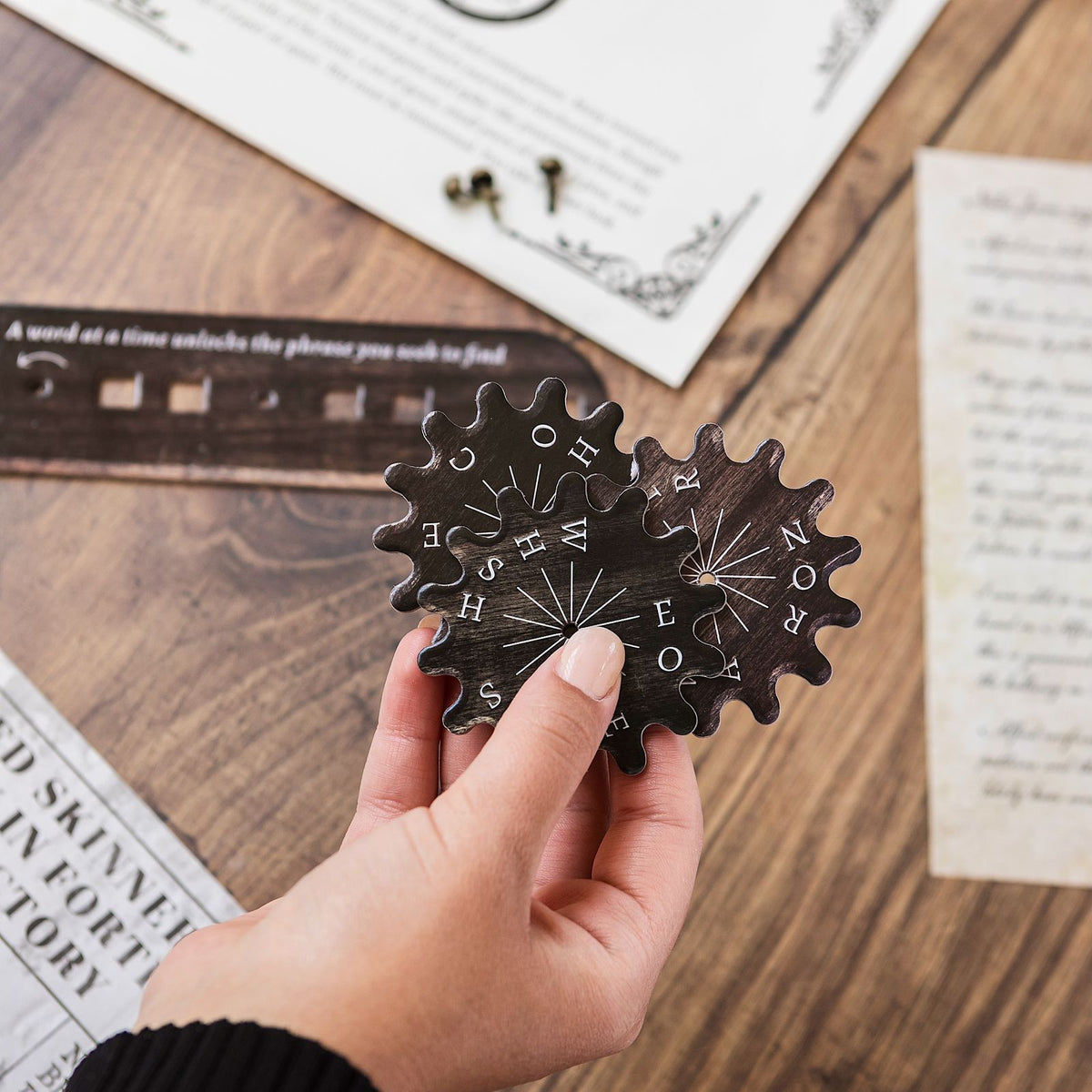
Assembly and jigsaws, torn strips whose edges dictate their own order, decoder wheels, keys and padlocks, boxes with compartments, things that fold or stack or line up.
Physical puzzles can give a clear result when the pieces fit. A large assembly is easy to share; a tiny lock or mechanism may still suit just one person at a time. Choose the scale to match the group.
Players may solve a small assembly by trying every arrangement. Decide whether that is a satisfying route or whether the pieces need clues that help them reason out the order. Also plan for the group’s vision, dexterity and movement needs; provide another way to use a component when necessary.
Physical puzzles don’t need expensive equipment. Card and paper can fold, rotate or line up to reveal information. In our own boxes, the puzzles require no cutting or writing on the materials, so the pieces can be kept for another player.
7. Word and language
Anagrams, acrostics, the first letter of every line, crosswords, a word hidden inside a paragraph, riddles.
Paper letters or simple tiles let players move possible answers around where others can see them. That can make an anagram easier to discuss than a word held in one person’s head.
Consider the group’s language skills. Anagrams and word riddles can be much harder for someone solving in a second language. A supplied word list or shorter answer can help, and a mix of puzzle types gives people other ways to contribute.
For a riddle, check whether more than one answer fits the wording. Another clue can help confirm the intended answer. Prepare hints or an alternate route if the riddle sits in a chain where everyone needs to solve it before moving on.
8. Information spread across several documents
The answer is not in any single item. A name sits in a letter, a date sits in a newspaper, a place sits on a map, and the answer is what appears when somebody puts the three together and says them out loud.
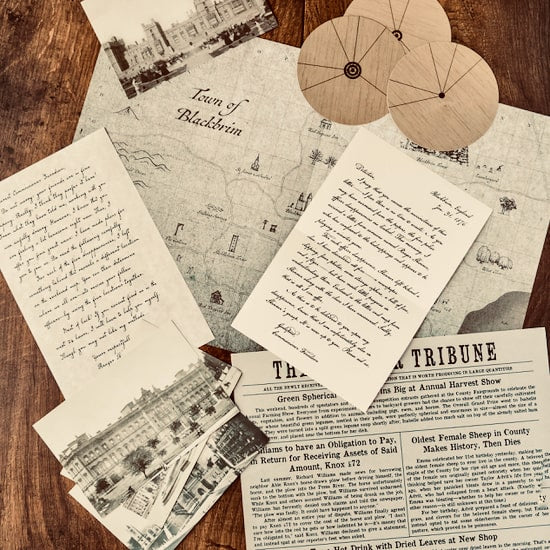
Several short documents are easy to share around a table. Give each one information that matters, then let players compare their findings. Keep the reading manageable so they can begin making connections early.
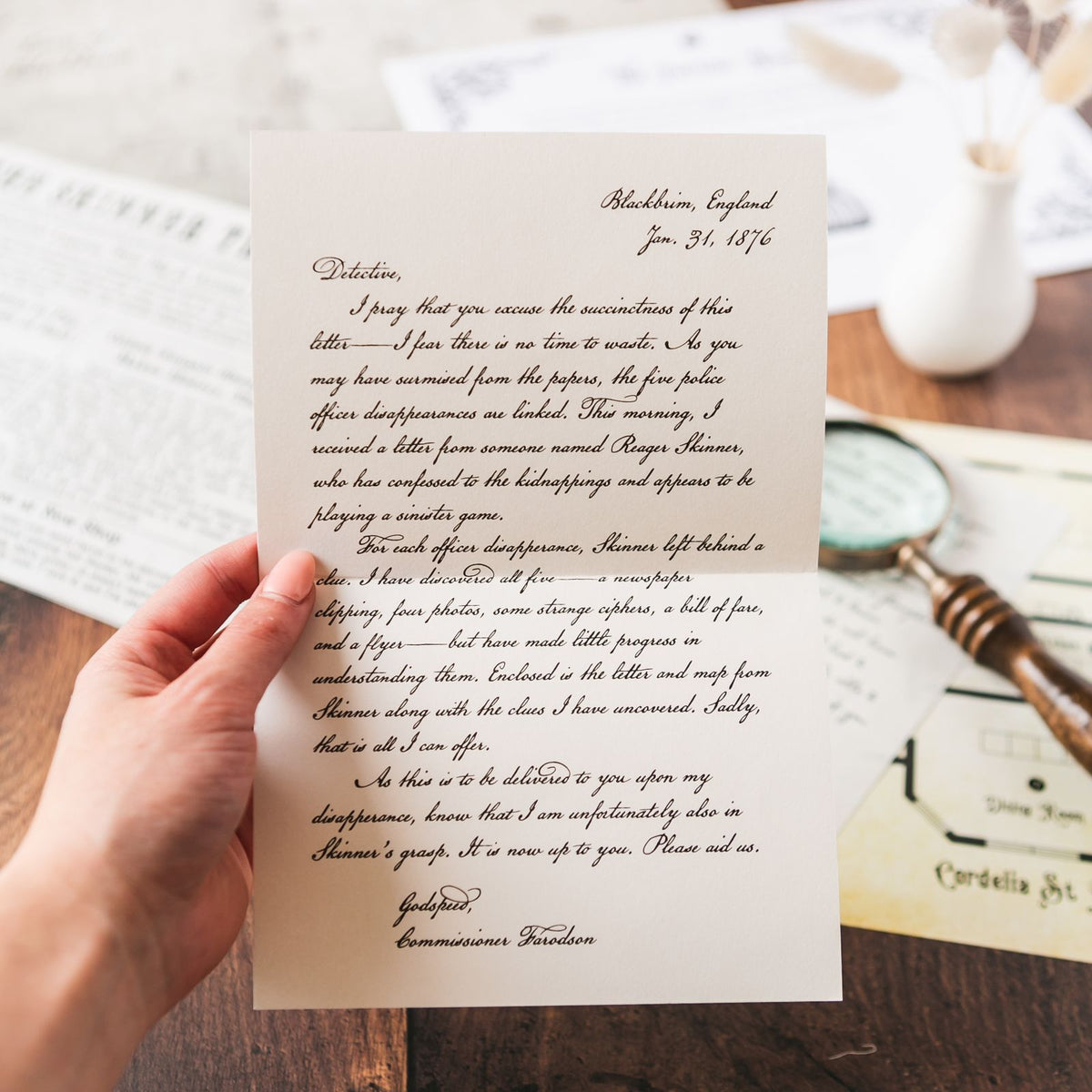
Blackbrim: 1876 uses this kind of physical material. Its first part includes a town map, letters, a newspaper and two wooden discs. You play a private detective following Reager Skinner’s trail in Victorian England. It plays with 1 to 6 people, ages 14+, over 2 to 4+ hours across two parts, and has 4.8 stars from 524 reviews.
Give players a clear question so they know what information to combine. Keep documents short enough to skim, and make relevant clues distinguishable from background story. An answer check helps them confirm that the connections they found are the ones the puzzle needs.
How to spread the types across a whole game
Vary the sequence as well as the types. If two puzzles both require one person to write for several minutes, separate them with something easier to share.
Alternate tasks that suit one person with tasks the group can share. For example, follow a short coded message with a map or assembly everyone can examine. Try the sequence with a group and adjust places where people are left waiting.
Common questions
These questions are useful when planning a home game.
What are the most common types of escape room puzzles?
Useful categories include ciphers, hidden messages, search and observation, patterns, logic, physical pieces, wordplay and information spread across documents. Many puzzles combine more than one type. Use the categories to plan variety, not to rank how often each appears.
Which escape room puzzle types work best for a large group?
Physical assembly, observation and information spread across documents are often easy to share. A logic grid can work too if players read clues and check each other’s deductions, or if you split useful information between them.
What makes an escape room puzzle unfair?
A puzzle feels unfair when it needs information players haven’t been given, has more than one plausible answer, or relies on a skill the group can’t reasonably use. Supply cipher keys, explain unfamiliar conventions and consider language, vision and handling requirements.
How many types of puzzle should one escape room use?
There is no required number. A mix of types helps avoid repetition, but the right choice depends on the length of the game and the group. Use enough variety that the next puzzle feels like a new task.
What is the easiest type of escape room puzzle to make?
A simple reveal is a manageable place to start. You could print a short message backward and provide a mirror, with a clue to use it. Physical puzzles can be simple too: paper strips or a folded card need little equipment. Test that the result is readable and gives players a clear next step.
Where to see these types in action
Try a few puzzles and notice which parts you enjoy solving or discussing. That can help you decide what to include in your own game.
Our free Puzzle Archive has fifteen browser puzzles with optional hints and answer checking. They range from introductory to expert. The Guardians uses knights-and-knaves logic, and Train Treason uses a coded note. Choose one to see which kinds of thinking you enjoy.
If you want paper on the table, use our separate free printable escape room puzzles guide. Print a few different types and see how your group shares the work before building a whole game.

For a complete boxed game, consider Down the Rabbit Hole. You’re finding a way out of Wonderland. It plays with 1 to 6 people, is rated 12+, and takes 1.5 to 3+ hours in one part. It has 4.9 stars from 82 reviews, and the materials can be kept intact to pass on.