Escape room and mystery games for kids, by age
Choose an escape room game for kids by the youngest person who will be solving, then check how much adult help it expects. For ages 5 to 7, start with EXIT: The Game Kids. At 8 or 9, EXIT's Family boxes offer two longer adventures.
Escape the Crate sells online family games that arrive by email in minutes. Finders Seekers runs a monthly kit, with a Junior Explorers line for ages 5 to 10 and a main line that suits a ten or eleven-year-old sitting alongside an adult. From 12 up, our own Down the Rabbit Hole is the game we would put on the table, and from 14 The Fifth Column is an option for a teen who enjoys codebreaking.
Our youngest recommended age is 12+, for Down the Rabbit Hole. The rest of our games are 14+, so the younger age groups below focus on games from other companies.
What to buy, by age
Start with the recommended age, then check how much adult help the game expects.
| Age | What we would buy |
|---|---|
| 5 to 7 | EXIT: The Game Kids, 20 minutes, picture puzzles, replayable |
| 8 to 9 | EXIT: The Game Family, two adventures of 45 to 75 minutes |
| 5 to 10, by subscription | Finders Seekers Junior Explorers, a monthly mystery kit set in a new country |
| 8 to 11, needed tonight | Escape the Crate's online family games, emailed in minutes |
| 10 to 11 | Finders Seekers, the main line, with an adult at the table |
| 12 to 13 | Down the Rabbit Hole, ours, 1.5 to 3+ hours |
| 14 and up | The Fifth Column, ours, 2 to 4+ hours |
Why so many escape room games for kids are rated 12+ or 14+
Most of our games are rated 14+, with Down the Rabbit Hole at 12+. Longer puzzle chains ask players to keep track of several clues and read the story closely. A child who enjoys a short riddle may still find a full box tiring, especially if the adults solve the hardest steps before they get a chance.
The same pressure explains the ratings you will see elsewhere. Escape the Crate puts it plainly in their own FAQ: their boxes are designed for ages 10 and up, but "this box is designed to be challenging for adults, so it might cause some frustration for very young players." Finders Seekers is blunter still on their playing page, recommending ages 10+ with adult help while noting the game "is challenging and designed for adults."
Look for a game designed for that age, and check whether its recommendation assumes an adult will help.
Ages 5 to 7: the EXIT Kids boxes
Thames & Kosmos makes a separate Kids line inside EXIT: The Game, with image-based puzzles for young solvers. Riddles in Monsterville takes 1 to 4 players about 20 minutes at ages 5 and up. Cookie monsters have stolen ten cookie jars and the puzzles win them back.
The puzzles do not depend on reading speed, and the decoder wheel checks the answer. That gives a child a way to work through the puzzle and find out whether it is right without handing every step to a parent.
Jungle of Riddles is the same format at ages 5 to 7, with treasure chests guarded by jungle animals. The Great Bee-scape and Midnight Spooktacular round out the line.
Worth knowing before you buy: the Kids boxes are replayable, because the puzzle cards recombine each round. The regular EXIT line works the other way. The manual for a standard title like The Venice Conspiracy says you can write on, fold or tear the materials, that this is sometimes required, and that "you can only play the game once." If a box needs to survive two children and a cousin, buy from the Kids line.
Ages 8 to 11: two boxes and one that skips the mail
At eight or nine, EXIT's Family boxes are the step up. EXIT: The Game Family, 2 Escape Adventures is listed at age 8 for 2 to 4 players, with two separate adventures of 45 to 75 minutes each. Five animal heroes investigate a manor and a candy factory. The adventures have a longer play time than the Kids boxes.
If the box needs to arrive tonight, Escape the Crate sells online-only games that skip shipping entirely. Escape: Reindeer Games is played in a browser, and their page states in capitals that it is easier than their other games and designed for families of all ages to play together. It also tells you that "parents should help out with this escape," which is the right expectation to set. Santa's reindeer have gone missing on Christmas Eve. Escape: Farmyard Frights carries the same family-designed line, with a Halloween monster party instead, so you are not stuck with a December theme in April.
There are two things to know about the online format. Your game code arrives by email within minutes of ordering, which makes it the only thing on this page that works as a last-minute gift. But once you click the link you have 72 hours to finish, and you cannot play it a second time. Start it on a morning when nobody has practice.
Finders Seekers Junior Explorers is built for ages 5 to 10. Each kit follows a destination through a four-day itinerary of puzzles and activities.
The main Finders Seekers line is for 1 to 8 players aged 10+ with adult help. Allow 1.5 to 3+ hours per box, with no time limit. Its stories avoid murders and violence, while the puzzles are designed to challenge adults too.
Escape the Crate says some of their boxes involve a murder mystery or mythological monsters, all presented in a PG way with no graphic violence, but a nine-year-old who is fine with a jewel heist may not be fine with the Ripper. Read the description of the specific title before you go by the age number on the box.
Ages 12 and 13: the box of ours that suits this age
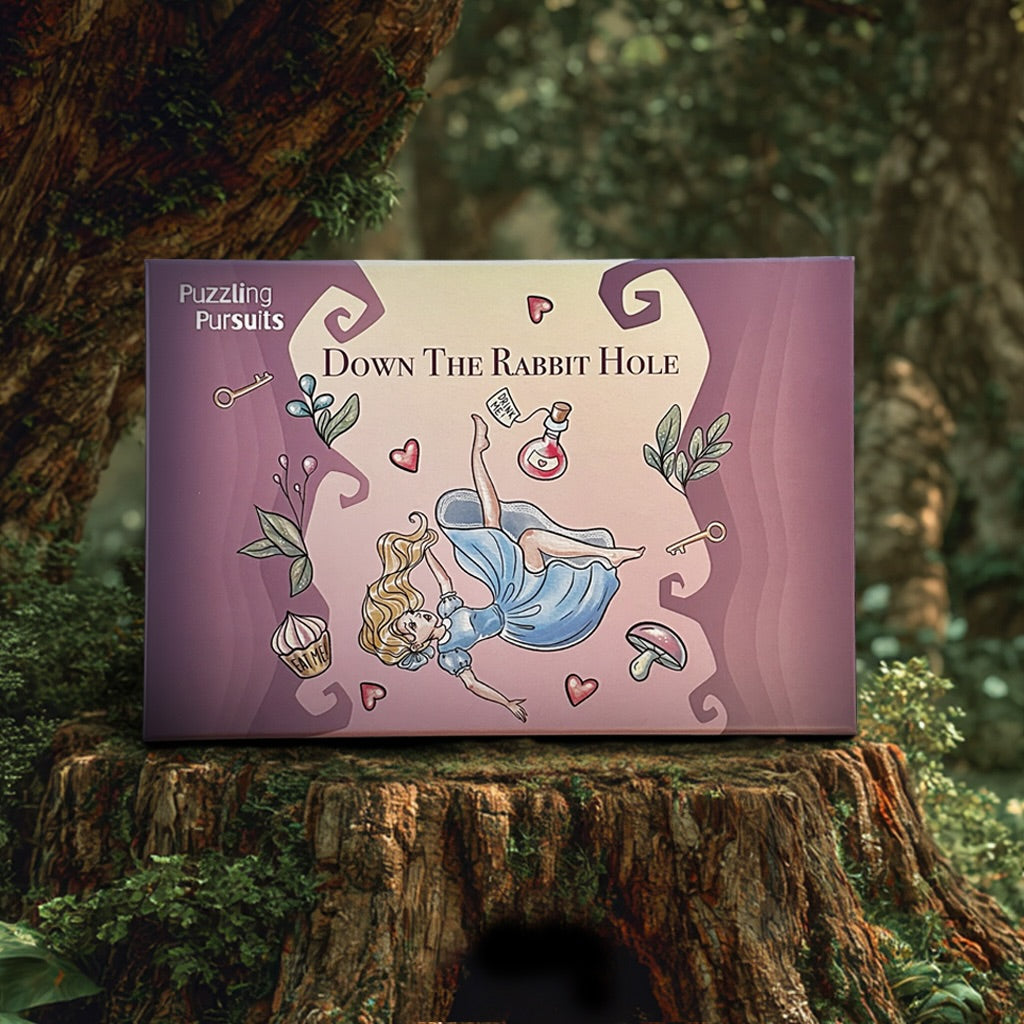
Down the Rabbit Hole is for 1 to 6 players aged 12+, with 1.5 to 3+ hours of play. It has one part, making it a shorter first game than our two-part boxes. You are in Wonderland and you are looking for a way out, through the Croquet Grounds, the Mushroom Grove, the Royal Court and the rest.

Down the Rabbit Hole is an introductory game for ages 12+. Flo W. called the puzzles "a great intro to how these games are played and for young players." Tyler H. wrote that "this one was a little more entry level so our 11 year old was able to join in the fun," describing a younger player joining a group. The age recommendation remains 12+.
Kathie D. described it as "well written for both adult and child alike." Skye called it a "great game for younger players" and "too easy for adults," so a group of experienced solvers may prefer one of our longer boxes.
You do not need to cut or write on the materials, so the finished game can be passed to another family. The online companion guide checks answers and offers optional hints, and there is no time limit.
For a first game with players aged 12+, see what comes in Down the Rabbit Hole. For a younger group, start with one of the age-specific games above.
What changes when the solver is eight
Keep the puzzle chain short. For under-tens, try three linked puzzles and let each answer lead to something they can find or pick up. A key or a newly opened envelope makes progress easy to see.

Plan a hint before the game starts. Our guide to designing escape room puzzles discusses pacing; for a child's game, aim to give them a useful next step if several minutes pass without progress.
Give everyone something to work on. A single logic grid can leave one child holding the pencil while the others wait. Separate clues or a second puzzle let more people contribute. Our guide to escape room puzzle types can help you vary the tasks.
Include any reference the players will need. A clock face or alphabet key may be useful even when the idea seems familiar to you. If a clue depends on a fact about history or a film, put that information somewhere they can find it.
Have an adult who knows the answers stay nearby. Watch for a child losing interest and offer a small hint before frustration takes over.
How to make a DIY escape room for kids at home
Plenty of parents searching for this end up building one instead, usually for a party where a single box does not stretch to nine children. It is very doable in an afternoon once you accept that the chain matters more than the cleverness of any single puzzle.
We wrote the long version in how to make your own DIY escape room at home, which covers the linear-versus-branching decision, a bank of puzzle mechanics that need nothing you do not already own, and how to write a three-tier hint before you need it. Mirror writing and a jigsaw with a message on the back both land well with under-tens and cost nothing.
DIY escape rooms for teens, and what to buy at 14
For teens, try a cipher with a key they can work out how to use, and open two puzzle strands at once so several people can solve together. Adjust the hints to the group's experience.
For ages 14+, The Fifth Column offers 2 to 4+ hours of codebreaking across two parts for 1 to 6 players. Our guide to gifts for teenagers compares it with other choices for different interests.
You play a codebreaker in Manhattan in June 1945, the people you are chasing are Nazi loyalists who kept going after Germany surrendered, and the box is full of reproduced wartime documents. Our own product page puts the 14+ line down to puzzle difficulty and says the material itself is fine for younger players. Check that the wartime story suits the person you are buying for. Apart from Down the Rabbit Hole, everything else we make sits in that same 14+ band.
Two free things you can try tonight
Try a free puzzle together before buying a full game. You will get a better sense of whether they enjoy decoding clues and how much help they need.
Escape the Crate runs a free online mini-mission called Escape: Safe-Cracker, a short browser puzzle in which you work two dials and a chain off a safe using the objects in a museum. It starts on the first click, with no email address and no account.
Our own free Puzzle Archive is the other option, with one caution attached. The fifteen puzzles are solved in the browser with optional tiered hints and graded from introductory to expert, and the three introductory ones are the place to start a child. Ten of them are also available as free printable escape room puzzles, which is the easier format for a party or a classroom. The caution is the framing: the story wrapped around each puzzle is written for adults, with spies and cold cases in it, so read the setup before you hand the screen over.
Questions about escape room games for kids
What age can kids start playing escape room games?
EXIT: The Game Kids boxes are rated 5+. Their image-based puzzles require no reading and run about 20 minutes. For older children, check both the age rating and whether the publisher expects an adult to help.
Can a 10 year old play Down the Rabbit Hole?
Down the Rabbit Hole is rated 12+. Some younger players have enjoyed it alongside older children or adults, but a ten-year-old solving alone may prefer an EXIT Kids or Family box.
Which kids mystery box has no murder in it?
Finders Seekers, whose own page states the content is "always family friendly (no murders or violence)," and whose Junior Explorers line runs for ages 5 to 10. Escape the Crate's catalog is mixed: some titles are heists or expeditions, others are murder mysteries, all presented in a PG way with no graphic violence, so check the individual title rather than the age rating.
What is a good escape room game for a 14 year old?
The Fifth Column is an option for a fourteen-year-old who enjoys codes and a wartime story. It is for 1 to 6 players aged 14+, with 2 to 4+ hours of play across two parts. Choose by their interests and puzzle experience as well as their age.
How long should one puzzle take a child?
Keep the steps short enough that the child can see progress. If several minutes pass without a useful lead, offer a hint about what to look at next. The right pace depends on their age and puzzle experience.
Are these games worth it for one evening?
An EXIT Kids box is replayable because the puzzle cards recombine each round, so it is not a single evening. The standard EXIT line is single-use, since the manual tells you to write on, fold or tear the materials. Our own boxes need no cutting or writing, so a finished game can be passed to another family intact.