Games like Deadbolt Mystery Society: where to go next
If you liked Deadbolt Mystery Society's case files, start with Unsolved Case Files or Cryptic Killers. If you want more codebreaking, try our at-home escape room games. EXIT: The Game suits a shorter evening, while Finders Seekers swaps the crime story for travel puzzles. And if the subscription is your only complaint, check Deadbolt's one-time boxes before changing companies.
We make Puzzling Pursuits, one of the options below. Our games focus on solving puzzles within an adventure; a Deadbolt box centers on a murder mystery. That difference matters more than which box has the most paper in it.
Check Deadbolt's one-time boxes first
Deadbolt sells subscriptions and one-time boxes. Compare the current product pages and check the cart total before ordering; an older Frequently Asked Questions page or comparison article may quote a different price.
They sell one-time boxes with nothing recurring attached. If you liked the games and only disliked the recurring charge, a one-time box lets you keep the same format without a subscription.
One other thing their FAQ is clear about: subscriptions are US only.
For a present, our guide to murder mystery gifts can help you weigh a single box against a gift subscription.
Deadbolt Mystery Society alternatives, compared
Compare the recommended ages and group sizes before choosing a game.
| Game | Hours | Players | Age | Recurring |
|---|---|---|---|---|
| Deadbolt one-time box | 2 to 3 | 1 to 4 | 13+ | No |
| Deadbolt subscription | 2 to 3 a box | 1 to 4 | 13+ | Yes |
| Hunt A Killer: Death at the Dive Bar | 45 to 60 min | 1 to 5 | 14+ | No, bar an optional perks membership |
| Unsolved Case Files | 2 to 6 | No stated limit | 14+ | Optional |
| Cryptic Killers | 2 to 3.5 | 1 to 10 | 14+ | No |
| Puzzling Pursuits | 1.5 to 4+ | 1 to 6 | 12+ or 14+ | No |
| EXIT: The Game, standard titles | 1 to 2 | 1 to 4 | 10+ or 12+ by title | No |
| Finders Seekers | 1.5 to 3+ | 1 to 8 | 10+ with adult help | Yes |
What you get in a Deadbolt box
Each standard mystery box is a self-contained murder mystery. You read a beginning brief, work through documents of different sizes and types, and solve puzzles whose answers are the passwords for QR-coded files, which push the story forward and occasionally tell you to open a sealed envelope. These standard boxes stand alone, so there is no season arc to keep up with and no wrong order to play them in.
Their product pages quote roughly 2 to 3 hours for 1 to 4 participants, ages 13 and up, with no time limit. You need a phone, tablet or laptop with a QR reader and an internet connection, since that is how the game advances.
They have also added a slower format worth knowing about. The Letters line sends twelve envelopes over twelve weeks that build one story, and The Halloween Letters is a single box their page quotes at 8 or more hours.
If the monthly charge is the problem
A one-time Deadbolt box may be enough. Hunt A Killer is another option if you want to try a different case-file game.
Hunt A Killer
Hunt A Killer's individual cases can be bought without a subscription. Its optional Evidence Locker membership renews annually and offers perks; it does not include case purchases.
The publisher also sells premium cases and season box sets. Compare the specific title's advertised play time and current availability.
Hunt A Killer is worth a look if you enjoy reading evidence and want a case with a shorter advertised play time. If you are weighing their catalog against ours rather than against Deadbolt's, our guide to games like Hunt A Killer sets out which three of our boxes suit that player best.
If you have run out of Deadbolt boxes
These two keep the familiar format: one case, a pile of evidence, and a solution to work toward over an evening.
Unsolved Case Files
Unsolved Case Files gives you one cold case per file. You read the clippings, police documents and photographs, then work three sequential objectives and check answers against an online key that hands out three escalating hints when you get one wrong. Their FAQ says most groups of two or more take 2 to 6 hours.
It sets no player limit at all, because everyone works the same pile of more than fifty documents together, and it suggests splitting into competing teams above six or eight people. Their FAQ puts the game at ages 14 and older and says they keep the content at a level that would pass as a PG-13 movie, adding that younger teens may want an adult alongside them. They sell single cases and three-case bundles, so you can start with one case before choosing a bundle.
Check the purchase type before ordering. Unsolved Case Files now runs a subscription of its own, sold in six and twelve-month plans paid up front or monthly, US customers only, cancellable any time with no fee. Choose a single case if you do not want a recurring order.
Its case-file format is a close match for Deadbolt, and its group guidance allows more players than Deadbolt's recommended four. If you are weighing it against Hunt A Killer specifically, we compared the two in Unsolved Case Files vs Hunt A Killer.
Cryptic Killers
Cryptic Killers is a British company doing cold-case deduction with a twist that suits anyone who liked Deadbolt's QR gating. Some of the evidence lives in bespoke websites, so you log into a police database or read phone records as well as shuffling paper. Their case files hold 26 to 36 pieces of physical evidence and run 2 to 3.5 hours depending on the title, for 1 to 10 players, ages 14 and up.
Their own shop sells in pounds with free UK delivery, and there is a licensed Peaky Blinders title alongside the standard cases. US buyers generally go through their Amazon listing, which is separately priced rather than converted from sterling.
They also rate every case for difficulty, which helps you choose a starting point, and our full guide to games like Cryptic Killers compares their whole catalog against the rest of this field.
For a wider whodunit shortlist, our guide to choosing a murder mystery box compares complete cases by group size and the kind of solving involved.
If Deadbolt was too easy, or too hard
Difficulty ratings can help you choose within a publisher's range. They are less useful for comparing different companies, since each uses its own scale.
Look for a rating on the specific Deadbolt box you played, then compare it with the other titles on their store. A similar rating suggests a similar challenge within that catalog, but it cannot tell you exactly how long your group will take.
Cryptic Killers also rates its cases. Murder at the Movie Theater is listed at 3 out of 5 and about two hours; Murder in Market Hill is listed at 5 out of 5 and about three hours. That gives you a choice within its own range.
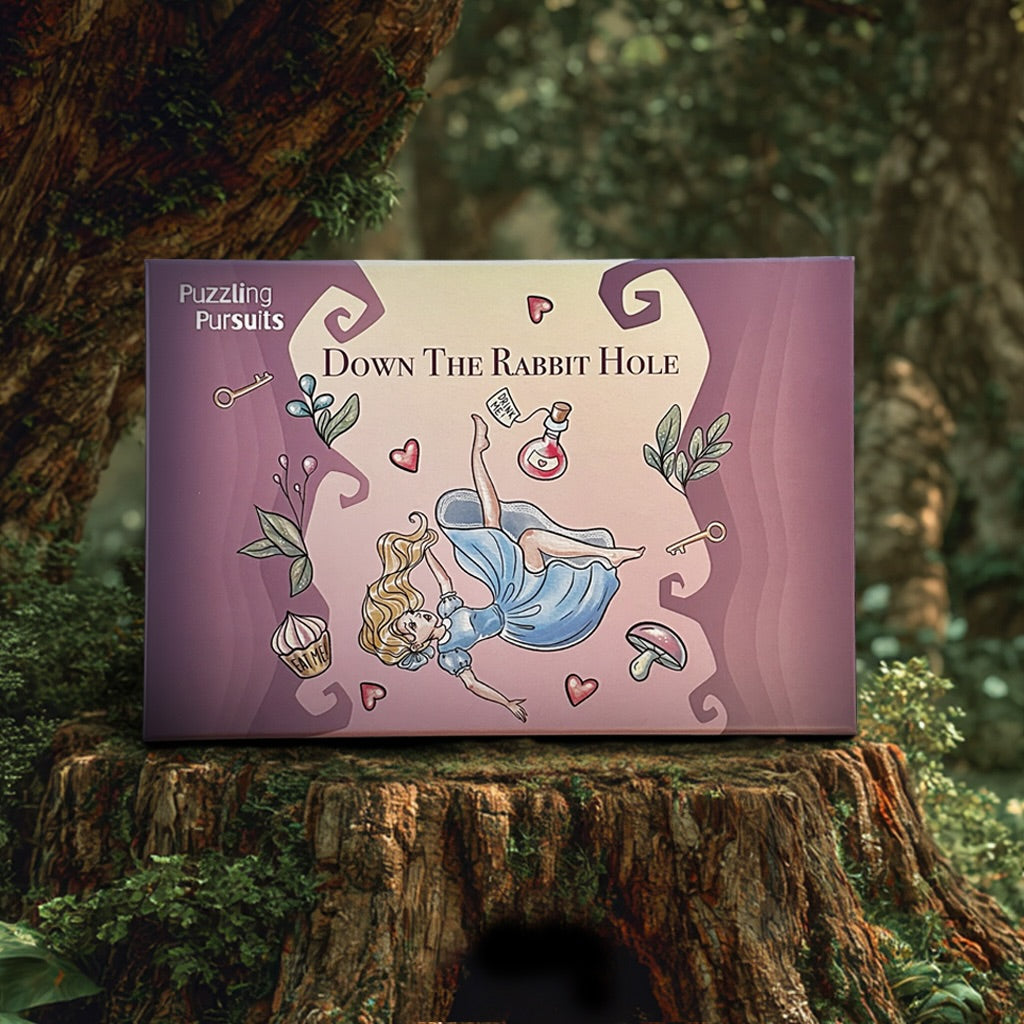
We do not publish numerical difficulty ratings for our games. Down the Rabbit Hole is our introductory box; the other boxes suit players who want a longer challenge. Each has optional hints in the companion guide.
You decide when to use a hint. There is no time limit, hints are graded so you can take the smallest one that unsticks you, and the companion guide checks answers as you go. Reviews show how much the same game can vary between groups. One player wrote "amazing, difficult but not too difficult". Another finished the same game and wrote "we loved it however it was very difficult and took us about 8 hrs". A third told us the puzzles were "a bit too hard without more direction". Allow extra time if your group prefers to work through a difficult puzzle before taking a hint.
Puzzling Pursuits, for more codebreaking
Our games ask you to work out how the clues fit together and turn what you find into an answer. You might decode a message or spot a pattern hidden in the printed materials. That makes them a good next step if the puzzle-solving was your favorite part of Deadbolt and you want more of it.

Most of our boxes contain two parts of one story, so you can pause at the break and finish another evening. They support 1 to 6 players, including solo play; Deadbolt recommends 1 to 4. For a larger gathering, check that everyone will have enough room to see and handle the materials.
None of our puzzles require cutting or writing on the materials, so a finished game can be handed to a friend intact. Deadbolt's pages do not address this either way, so check before you plan to pass one on.
- The Fifth Column puts you in Manhattan in June 1945, working to stop a Nazi plot after Germany's surrender. It is for 1 to 6 players aged 14+, with 2 to 4+ hours of play across two parts and 4.9 stars from 152 reviews.
- Blackbrim: 1876 follows a private detective's pursuit of Reager Skinner through Victorian England. It is for 1 to 6 players aged 14+, with 2 to 4+ hours across two parts and 4.8 stars from 524 reviews.
- Down the Rabbit Hole is our introductory Wonderland adventure. It has 1.5 to 3+ hours of play in one part for 1 to 6 players aged 12+, with 4.9 stars from 82 reviews.
If you want to spend your next game night cracking wartime codes, see how The Fifth Column works. It holds 4.9 stars from 152 reviews, and one of them is from a WWII living-history reenactor who owns an M-94 cipher device and an M-209 cipher machine and still told us it was not easy.
Well designed, challenging but not impossible, with a nice variety of puzzles so there is something for every type of thinker.
Leah C. on The Fifth Column, verified review
EXIT: The Game, if you want it shorter and cheaper
EXIT from Thames & Kosmos offers compact puzzle adventures. The catalog runs past fifty titles, and the age line moves between them: The Secret Lab and The Forbidden Castle are both 12 and up, while the licensed Lord of the Rings game is 10 and up. Read the specific title before you buy it for a younger table.
Choose EXIT if you want a sequence of puzzles to solve. If you mainly enjoyed weighing evidence against suspects in Deadbolt, a case-file game will be a closer match.
The other trade is permanent, and their own rulebook explains it. The Secret Lab manual, which you can download from its product page, tells you that "You can write on, fold, or tear the materials", that doing so is "sometimes even required", and that "You can only play the game once", after which you will not need the materials any longer. Scissors are offered as a tidier alternative to tearing. A standard box is spent when you finish it, so this is the one game here you cannot hand on. Their separate Kids line, for ages 5 to 7, is replayable.
If it was too grim for your table
If a murder story put someone off the last game, look at the setting before comparing difficulty or play time.
Finders Seekers
Finders Seekers is the pick when the problem was tone. They ship a different real-world destination every month with puzzles built around that culture, and their content is "always family friendly (no murders or violence)", so you can choose it for a group that wants to avoid crime stories. Their pages put it at 1.5 to 3+ hours for 1 to 8 players, ages 10 and up, and they run a separate Junior Explorers line for ages 5 to 10 and over.
Read their own age note carefully before buying it for a young table, because their playing page follows the 10+ recommendation with "the game is challenging and designed for adults". They sell month to month and in three, six and twelve-month prepaid plans, so check which purchase option suits you. You need internet access to play, as with Deadbolt.
How to pick, quickly
Answer one question: what sent you looking for something else?
| What sent you looking | Where to go next |
|---|---|
| The monthly charge | Deadbolt's own one-time boxes, or Hunt A Killer |
| You have played all of them | Unsolved Case Files or Cryptic Killers |
| You want to know the difficulty before you buy | Cryptic Killers |
| You want more codebreaking | The Fifth Column or Blackbrim: 1876 |
| You want a shorter listed play time | EXIT: The Game |
| Too grim for the table | Finders Seekers |
| More than four people wanting to play | Unsolved Case Files, or our games at 1 to 6 |
| Wanted more than one evening out of it | The Blackbrim Trilogy, or Deadbolt's Letters line |
If you want the long version of ours
The Blackbrim Trilogy collects all three Victorian games. It runs 10+ hours across six parts for 1 to 6 players, ages 14+, and carries 4.9 stars from 533 reviews.
Common questions
What are the best alternatives to Deadbolt Mystery Society?
Unsolved Case Files and Cryptic Killers keep the cold-case format. Hunt A Killer offers individual cases with different themes and play times. Choose our games for more codebreaking, EXIT for a shorter puzzle adventure or Finders Seekers for travel puzzles without murder stories.
Can Deadbolt prices change between pages?
Prices and plans can change. Use the current product page and check the cart total before ordering; an older FAQ or comparison article may quote a different figure.
Can you buy Deadbolt boxes without a subscription?
Yes. Deadbolt sells one-time boxes as well as subscriptions. If the recurring charge was the only thing you wanted to change, look at the individual titles first.
How long does a Deadbolt box take?
Their product pages quote roughly 2 to 3 hours for 1 to 4 participants, ages 13 and up, with no time limit. The Halloween Letters is the exception at 8 or more hours, and their Letters line spreads one story across twelve weekly envelopes.
Do you need a phone to play Deadbolt?
Yes. Puzzle answers double as the passwords for QR-coded files that carry the story forward, so you need a QR reader on a phone, tablet or laptop and an internet connection. Cryptic Killers, Finders Seekers and our own games also use online components, including our companion guide for hints, answer checking and story progression.
Are any of these good for a family with younger players?
Finders Seekers, whose own page says the content is family friendly with no murders or violence and recommends ages 10 and up, with a separate Junior Explorers line for ages 5 to 10 and over. The same page warns that the main game is still designed for adults, so read that before buying it for young solvers. EXIT titles are commonly 10 or 12 and up. Deadbolt is 13+ and most of the rest of this category is 14+. Ours are 14+ except Down the Rabbit Hole at 12+.
Check each linked product page for its current specifications and availability.