
Article: Down the Rabbit Hole: Fact or Fiction?
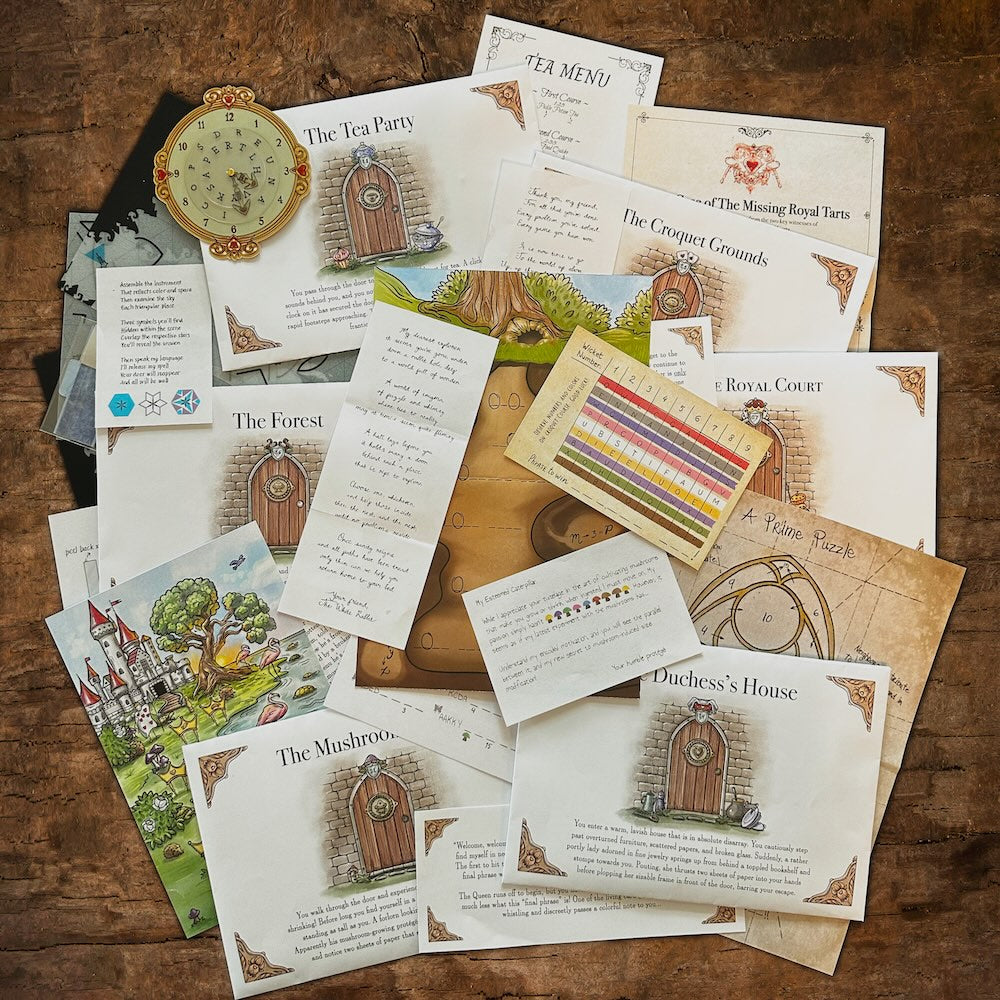
Down the Rabbit Hole: Fact or Fiction?
Lewis Carroll and Alice’s Adventures in Wonderland

Lewis Carroll was the pen name of Charles Lutwidge Dodgson, an English writer and mathematician. Alice’s Adventures in Wonderland was published in 1865; its wordplay and absurd arguments are a large part of its appeal. Carroll later wrote Through the Looking-Glass, which includes “Jabberwocky.” You can read the original Wonderland text alongside the comparisons below.
The tea party

The Mad Hatter’s tea party is one of the most iconic scenes from Alice’s Adventures in Wonderland. In the book, The Mad Hatter, March Hare, and Dormouse are stuck at a tea party in which time has stopped. The Mad Hatter explains that he quarreled with Time during a concert for the queen, and ever since time has been stuck at six o’clock. Our game includes a new character (the Grandfather Clock), a reason for their quarrel (the new second hand), and the tea menu, but the theme stays very close to the original scenario.
The mushroom grove

Another of the iconic scenes from the original book is Alice’s encounter with the caterpillar. In this scene, Alice comes upon a giant mushroom with a large caterpillar sitting atop its cap, smoking hookah. The caterpillar is a bit aloof, irritable, and condescending, giving cryptic advice instead of straightforward answers. Alice discovers that eating one side of the mushroom will make her grow, while eating the other side will make her shrink. Our story keeps the caterpillar’s attitude and the shrinking/growing mushrooms, but puts the scene in a grove, modifies what signifies shrinking/growing and adds the protege character.
The Duchess’s house

In the book, Alice stumbles into the Duchess’s house in the midst of a fight between the Duchess and the cook. During the fight, the cook is hurling fire-irons, saucepans, plates, dishes, and eventually a frying pan at the Duchess. In the scene, the Duchess is rude and impatient. Our story is set in a fictional aftermath of this fight, in which a stained glass window in the house is broken. Later in the original text, Alice runs into the Duchess again, who is much more pleasant. This is the root of the somewhat surprising turn in temperament in our game, when the Duchess calms down and allows you to leave.
The forest

The forest is a recurring setting within Alice’s Adventure, though Lewis Carroll often calls it “the wood”. Alice heads through forested regions in between many of the locations she visits. Our forest scene is most inspired by Alice’s trip between the Duchess’ House and the Tea Party, in which the Cheshire Cat appears on a tree bough, then disappears and reappears, pointing Alice in the direction of the tea party. Our scene is also inspired by the Cheshire cat’s appearance in the Queen’s Croquet game, in which the cat’s smile appears in the air near Alice. The stars and the field mouse were our invention.
The croquet grounds

Alice also plays a croquet game with the Queen in the original book - complete with flamingo mallets, hedgehog balls, playing card guards and gardeners. In fact, Alice notes how her flamingo keeps looking up at her, and the hedgehog keeps wandering away, which we included elements of. The wickets in the original, however, were the playing card guards themselves, bending over so their hands and feet touch the ground. Alice also never completes the game as there is an argument about beheading the Cheshire Cat (ordered by the Queen) because it won’t leave or kiss the King of Heart’s hand. The wickets and the logic in our game were our own invention.
The royal court

The royal tarts are indeed stolen in the original Alice’s Adventures in Wonderland, and there is also a trial that Alice stumbles into in which a cryptic note is produced as evidence. The King and Queen are presiding over the trial in the book, however, and the Knave of Hearts (Jack) is already in chains as the potential culprit. Our specific proceedings, note, and puzzle are our own creation.
The final rabbit hole

The courtroom is the final scene in Wonderland. Alice grows during the trial, challenges the Queen and is swarmed by the playing cards. Then she wakes with her head in her sister’s lap beside the river. Our game changes the ending and gives the rabbit hole a larger role in the way out.
Thanks for playing. For another evening in Wonderland, our Down the Rabbit Hole game-night guide has tea-party recipes and music. You can also choose your next at-home escape room game.

