Article: What is a cryptid?

What is a cryptid?
A cryptid is an animal whose existence or survival to the present day is disputed or unsubstantiated. Bigfoot and the Loch Ness Monster are famous examples. The word is only about four decades old: J. E. Wall created it in 1983. This page covers the word's history and the dates behind famous reports, followed by documented animal discoveries and our Cryptid expedition game.
What does cryptid mean, exactly?
The definition of cryptid covers two kinds of claim. One proposes an animal whose existence hasn't been established; the other proposes that an animal believed extinct is still alive. Calling something a cryptid describes the uncertainty around the claim. It doesn't confirm that the animal exists.
A cryptid is claimed to be a real, living animal, which is the useful distinction from a dragon or unicorn in a story. Our creature-by-creature field guide, linked below, looks at the individual accounts.
Cryptozoology is the search for and study of these animals, and it is also a subculture. Its interests include legendary animals and those believed extinct. Academics broadly regard cryptozoology as a pseudoscience.
Who coined the word cryptid, and when?
J. E. Wall coined cryptid in the summer 1983 issue of the International Society of Cryptozoology newsletter. The name for the field had arrived earlier: cryptozoology was already in use by 1959.
The field grew out of work by Belgian zoologist Bernard Heuvelmans and Scottish zoologist Ivan T. Sanderson. Heuvelmans published On the Track of Unknown Animals in 1955 and credited Sanderson with coining cryptozoology.
The word cryptid is younger than several of its famous examples: the modern Loch Ness reports and the naming of Bigfoot both came before 1983.
When were the famous cryptids first reported?
Here are the dates behind some familiar reports and later investigations, alongside the places associated with each cryptid.
| Year | Cryptid | Where | What happened |
|---|---|---|---|
| 1933 | Loch Ness Monster | Loch Ness, Scotland | George Spicer and his wife reported a sighting on 22 July. Modern interest began with that report. |
| 1934 | Loch Ness Monster | Loch Ness, Scotland | The “Surgeon's Photograph”, attributed to Robert Kenneth Wilson, became the creature's most famous image. |
| 1958 | Bigfoot | Humboldt County, California | Bulldozer operator Jerry Crew found 16-inch footprints, and logging crews began calling their supposed maker “Bigfoot”. |
| 1966 | Mothman | Point Pleasant, West Virginia | Two couples made the first report on 15 November. |
| 1967 | Bigfoot | Bluff Creek, Northern California | The 59.5-second Patterson-Gimlin film was shot on 20 October. |
| 1991 | Loch Ness Monster | Loch Ness, Scotland | In January, Christian Spurling admitted that the “Surgeon's Photograph” was a hoax built around a toy submarine; that explanation has been widely accepted since 1994. |
| 1995 | Chupacabra | Puerto Rico | The first attack later linked to the creature was reported in March. |
For creature-by-creature accounts beyond these dates, read our longer field guide to the cryptids people actually look for.
One of the first Mothman witnesses described a slender, muscular figure about seven feet tall with white wings. Reports continued until 15 December 1967, the day the Silver Bridge collapsed and killed 46 people. John Keel's 1975 book The Mothman Prophecies later tied those events together.
Have any cryptids turned out to be real?
Some real animals have histories of rumours or presumed extinction. We describe them that way here; calling them “former cryptids” would go beyond what those histories establish.
Okapi
Europeans in Africa had heard reports of an animal they called the African unicorn. The okapi was formally recognised in 1901 as Okapia johnstoni, after Sir Harry Johnston obtained skin and a skull.
Coelacanth
The coelacanth had been thought extinct since the Late Cretaceous, about 66 million years ago. On 22 December 1938, museum curator Marjorie Courtenay-Latimer found a living one in a fisherman's catch off the Chalumna River in South Africa.
This answers the survival part of the definition: an animal believed to have died out was still alive.
Giant squid
Sailors' tales of giant squid may have led to the Norse legend of the kraken.
Tsunemi Kubodera and Kyoichi Mori took the first photographs of a live giant squid in its habitat on 30 September 2004. NHK and Discovery Channel crews captured the first deep-sea footage in July 2012.
Why did we build a game around a cryptid hunter?
We built Cryptid around the appeal of following an unfinished expedition. The missing man is Dr. Herbert Hughes, the players' uncle and a once-esteemed scientist and adventurer. His career crumbled as his obsession with cryptids took hold. He never returned from his latest expedition and is presumed dead. A young man arrives with a chest Hughes left before setting out.
See our Cryptid at-home escape room game for the expedition story: it supports 1 to 6 players aged 14+ and takes 2 to 4+ hours across two parts. Cryptid has 4.8 stars from 38 reviews.
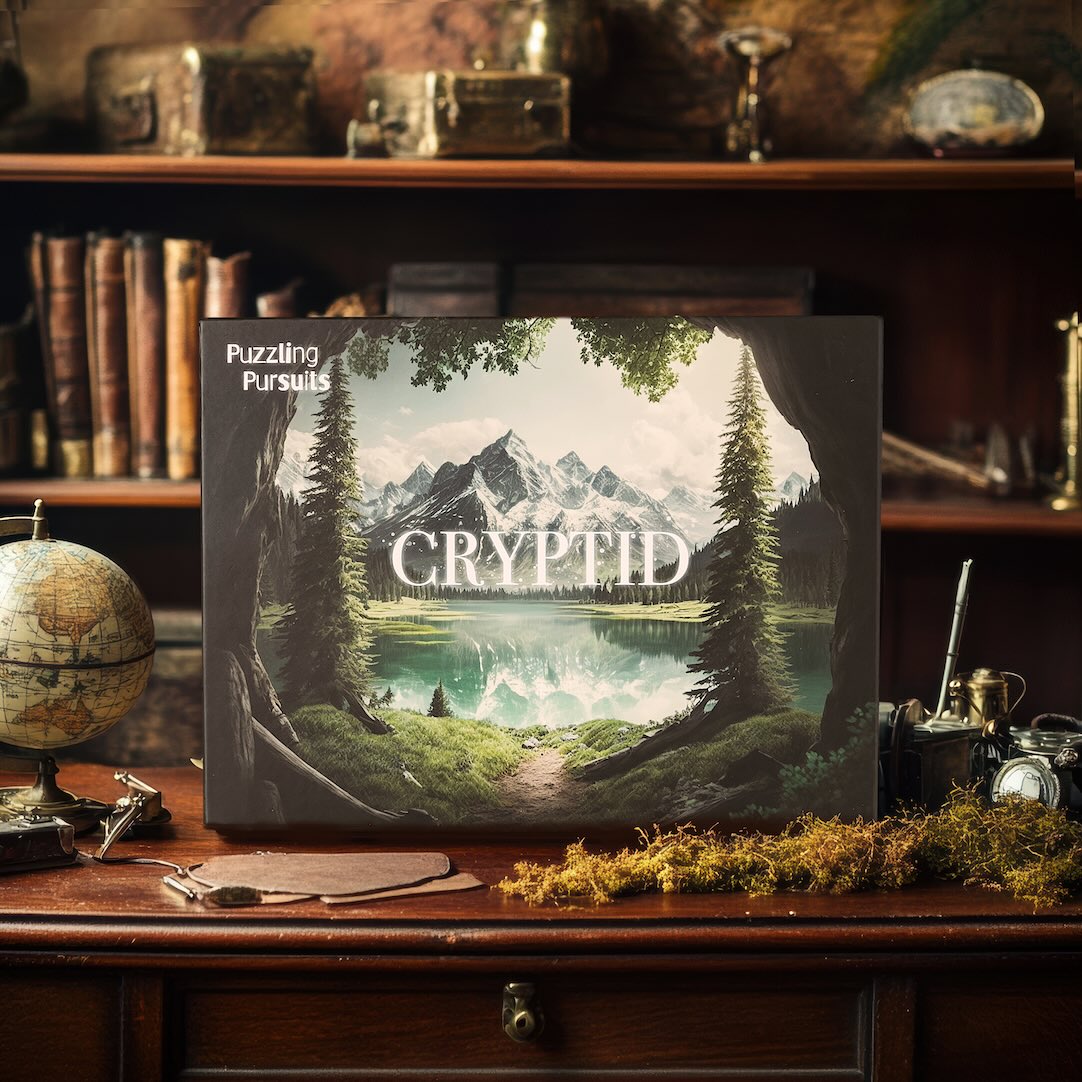
The game is about following his trail and solving what he left behind. That premise suits the way we design puzzles: each puzzle is a physical artifact with a hidden mechanism, and players operate it to extract an answer. We allow exactly one unclued “aha” per puzzle and use no red herrings.
We test each game with over a dozen people who think in different ways. Each puzzle often gets a few tweaks, though some need major revamps. Sometimes we have to start a puzzle from scratch.
At the table, players work with printed materials. Nothing requires cutting or writing on those materials, so a finished game can be passed on intact.
Our online companion guide offers hints that progress from a nudge to the mechanism to the answer, plus answer checking. There's no timer, and the story's two parts give players a place to pause.
What else should you know about cryptids?
These questions cover the word's origin and what the reported sightings can establish.
When did Bigfoot get its name?
Bigfoot got its name in 1958, after bulldozer operator Jerry Crew found 16-inch footprints in Humboldt County, California. Logging crews began calling the supposed maker “Bigfoot”.
Is cryptozoology a science?
Academics broadly regard cryptozoology as a pseudoscience. It searches for and studies animals whose present existence is disputed or unsubstantiated.
What happened to the Surgeon's Photograph?
In January 1991, Christian Spurling admitted that the 1934 “Surgeon's Photograph” was a hoax built around a toy submarine. That explanation has been widely accepted since 1994.
Is Bigfoot a cryptid?
Yes, Bigfoot, also called Sasquatch, is a cryptid associated with the United States and Canada. Its existence remains unsubstantiated.
When was a live giant squid first photographed in its habitat?
The first photographs of a live giant squid in its habitat were taken on 30 September 2004 by Tsunemi Kubodera and Kyoichi Mori. NHK and Discovery Channel crews captured the first deep-sea footage in July 2012.
Try our free Puzzle Archive, where fifteen browser puzzles range from introductory to expert and include optional hints and answer checking; our games hold 4.8 stars across more than 2,000 reviews.