New to solving puzzles? Try these beginner examples
If you're new to puzzle games, figuring out what to do can be the first puzzle. Start with the examples below. Each has hints you can reveal one at a time, so you can try an idea before checking the answer.
But first, what is a puzzle?
To many people, the term "puzzle" conjures the image of a jigsaw puzzle:

The puzzles in our games usually ask you to find a word, a number, or a hidden message. Two things make them different from following a set of instructions:
- These examples each have one answer, which may be a word or a short message.
- You are not given exact instructions for how to solve the puzzle; part of the challenge is figuring out how to solve it.
Try the first example, then open a hint if you need one.
1. A puzzle example
Alice left a shopping list for her husband Bill with a little puzzle inside. What is the third ingredient he should buy?

Click below to see if you got it, or view a hint:
Try to establish a relationship between the colors and the letters.
Each letter is associated with a specific color. For example: Rs are light green, and Es are white. You can use the color-letter combinations from the first two words to decrypt the final third word. The final word is:
WATERMELON
2. A second puzzle
The colors in the first puzzle gave you the method as well as the answer. This next one includes more instructions, but there's an extra step to work out before you can read the message.
Alice left Bill a note in the morning. What does her hidden message say?

Start by solving the Magic Square. There are a few ways to go about it.
One approach is to perform some guess-and-check work until you get the solution. Even with guess-and-check though, there are ways to narrow down the options. For example, you know that there are 5 numbers not currently being used - 2, 4, 5, 6, and 8. Putting each of these in the central square and summing the rows results in sums of 12, 14, 15, 16, and 18. You now know that all rows, columns and diagonals must each sum up to one of these 5 numbers.
A second approach is to notice that all of the odd numbers except for 5 are already placed in the magic square. It is useful to recognize that the sum of 2 odd numbers is even, the sum of 2 even numbers is even, and the sum of 1 odd + 1 even number is odd. Can you figure out where the 5 must go?
Here is how to figure out where the 5 must go. If 5 was placed in one of the corners, it would make the sum of the row and column it is in even. However, the diagonal it is placed in would be odd. Since the sum of the columns, rows, and diagonals must all be the same, placing 5 in a corner would therefore not work. So, 5 must go in the center.
You can also use a guess-and-check method to find the same solution.
Now that we know 5 must go in the center, placing the other 4 numbers becomes much easier. 1 + 5 + 9 = 15 and 7 + 3 + 5 = 15. So, we know that 15 is the sum of each row, column, and diagonal. The answer of the magic square (from left to right, top to bottom) is: 6 7 2 1 5 9 8 3 4.
Now, follow the instructions to shift the letters. The first B is in the same square as the 6, so shift B by 6 to get H. The second B is in the same square as the 7, so shift B by 7 to get I. And so on.
HI SWEETIE
3. A final puzzle
The next puzzle gives you several examples and asks you to find the rule that connects them. If you get stuck, the Pet Rock puzzle page has hints and an answer checker.
Alice has a rule for naming her pet rocks. Use the examples below to work out the fourth rock's name.


Check your Pet Rock answer in the archive, or use another hint before you commit to a name.
When you get stuck
Try saying your idea out loud, even if it sounds unlikely. Another player may notice a connection you missed. If you're playing alone, take a short break and come back to the clue. A hint can help you learn a technique you'll recognize next time.
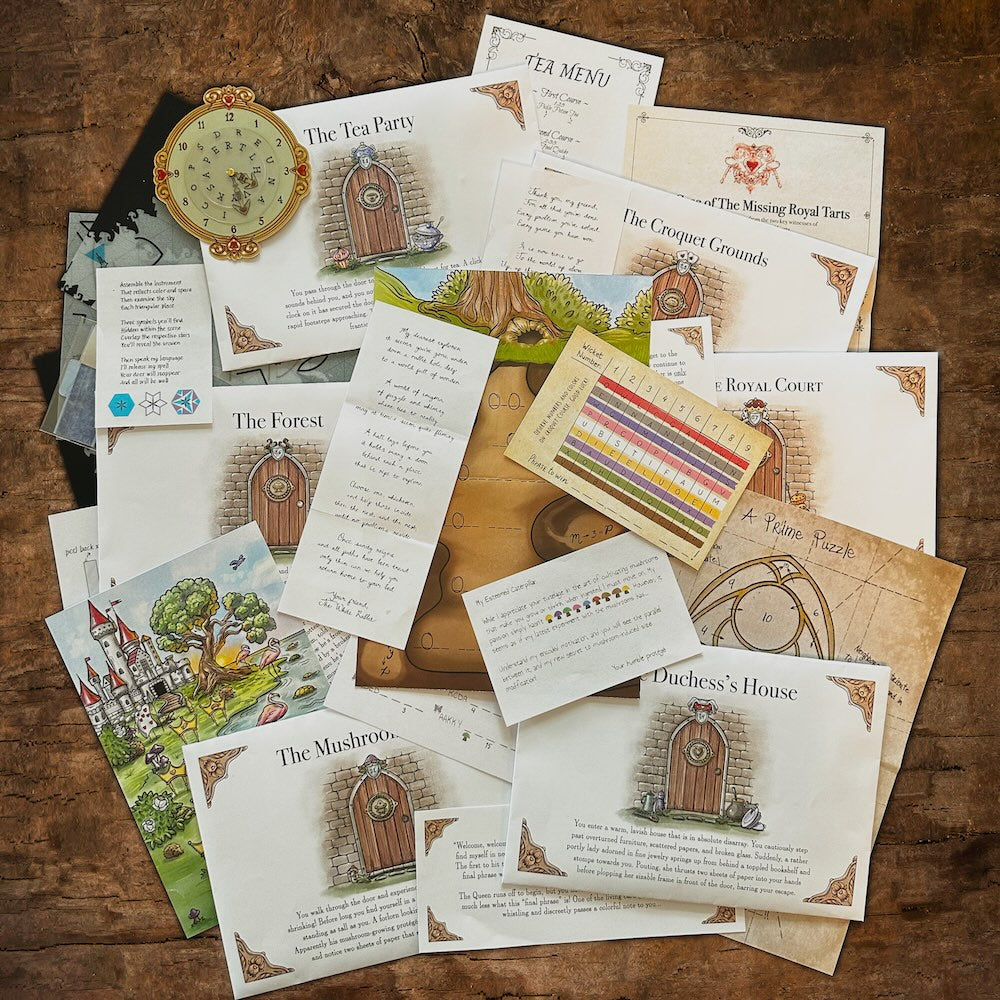
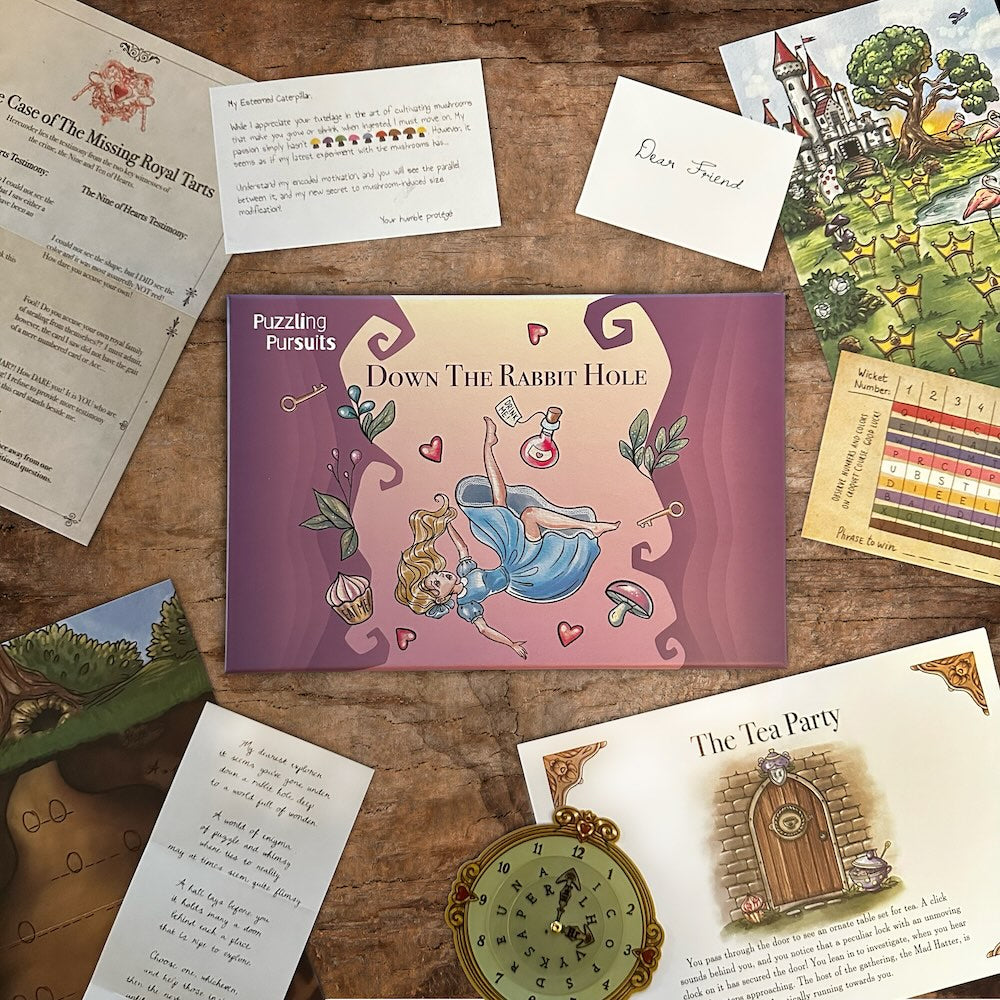
If you've enjoyed these examples, Down The Rabbit Hole gives you a whole Wonderland adventure to solve. It's our introductory game for 1 to 6 players, ages 12+, and takes 1.5 to 3+ hours. You can check answers and reveal hints in the online Companion Guide as you go.
For another short challenge, choose a free puzzle from the archive. Start at introductory level and work up whenever you fancy something harder.