Family game night: games for the ages at your table
For family game night, start with the youngest player and the time you have. Outfoxed! suits younger children; Sushi Go Party! and Just One keep older children involved; Codenames works well once the group enjoys word clues. For ages 12+ who want to solve together, a boxed escape room game is another option. The table below compares player counts, ages and playtimes.
The next thing to check is what happens between turns. Some families enjoy planning a move while someone else plays. Others have a better evening when everyone can talk, choose cards or solve at the same time.
Our own Down the Rabbit Hole is included below, alongside games from other publishers. It’s a shorter, single-part escape room game for ages 12+, which makes it a useful starting point for families with older children.
The question that decides whether family game night works
Ask what each player can do while someone else has the turn. A game can have a high player count and still leave several people waiting. In our guide to designing escape room puzzles, we look at ways to give a group several things to work on. The same idea can help you choose a family game.
Read the turn structure before buying. If players act one at a time, check whether a turn is quick and whether others can plan or contribute between turns. Simultaneous card choices and cooperative discussion are useful options for a group that gets restless while waiting.
Which family board games suit the ages at your table
An age rating is a starting point. Check how much reading the game needs and whether its decisions will interest both the youngest and oldest players. A short round is helpful when you’re trying something unfamiliar.
Here is the whole set in one place. Player counts, ages and times below are taken from each publisher's own product page, and the sections underneath explain the picks.
| Game | Players | Ages | Time | Why it holds a mixed table |
|---|---|---|---|---|
| Outfoxed! (Gamewright) | 2 to 4 | 5+ | 20 min | Everyone works together to catch the fox |
| Rat-a-Tat Cat (Gamewright) | 2 to 6 | 6+ | 20 min | Number cards and short rounds, with no text to read on the cards |
| Sushi Go Party! (Gamewright) | 2 to 8 | 8+ | 30 min | Players choose cards at the same time, then pass their hands |
| Just One (Repos Production) | 3 to 7 | 8+ | 20 min | Everyone writes a clue at the same time |
| Forbidden Island (Gamewright) | 2 to 4 | 10+ | 30 min | Players can discuss a plan together between turns |
| Codenames (Czech Games Edition) | 4 to 8+ | 10+ | 15 min | Teammates discuss guesses; the spymaster gives the clues |
| EXIT: The Game (Thames & Kosmos) | Varies by title | Varies by title | Varies by title | Compact adventures with different age and difficulty ratings; standard titles use up components |
| Down the Rabbit Hole (ours) | 1 to 6 | 12+ | 1.5 to 3+ hrs | Paper puzzles spread out, so several people work in parallel |
When the youngest is 5 to 7
Look for a game whose reading and counting requirements fit the child. Short rounds give you a chance to learn together without committing to a long session. A cooperative game lets adults and children work toward the same goal.
Outfoxed! from Gamewright is a cooperative game where everyone works together to catch the fox. It plays with 2 to 4 people, is rated 5+, and takes about 20 minutes. Rat-a-Tat Cat suits ages 6+ and takes about 20 minutes for 2 to 6 players. Its short rounds make it easy to try again after a disappointing hand.
When the youngest is 8 to 11
At this age, card drafting and word games give you more choices. Check the amount of reading and keep the first session short enough to learn without feeling rushed.
In Sushi Go Party!, everyone chooses a card at the same time, then passes their hand to the next player. It keeps the whole table involved and accommodates a larger family: 2 to 8 players, ages 8+, in about 30 minutes.
In Just One, everyone except the guesser writes a one-word clue at the same time. Duplicate clues are removed before the guesser sees them, so an unexpected word can be more useful than an obvious one. It plays with 3 to 7 people, is rated 8+, and takes about 20 minutes.
Forbidden Island is a cooperative game for 2 to 4 players, ages 10+, that takes about 30 minutes. Players take turns, but they can discuss how to collect the treasures and escape before the island sinks.
Ticket to Ride is worth considering for a family that enjoys planning routes. It plays with 2 to 5 people, ages 8+, in about 30 to 60 minutes. Turns happen one at a time, so it may suit a patient group better than one that wants everyone acting at once. It also won’t seat a family of six.
When everyone is 12 or older
With older children, you can consider longer games and more reading, but interests and experience still matter. Ask whether the group wants word clues, strategy or a story to solve together.
If you're choosing a present for a teen in the family, see our guide to gifts for teenagers.
Codenames is an option for teenagers and adults who enjoy word association. Two teams take turns giving one-word clues and discussing which words on the table fit. It lists 4 to 8 or more players, ages 10+, and roughly 15 minutes per round. The spymaster and guessers have different jobs, so swap roles between rounds.
EXIT: The Game has standalone adventures with different age and difficulty ratings. Read the details for the title you choose. Standard games use materials that you may need to fold, mark or cut, so they suit a family that is happy with a single-use experience. For younger children, see our escape room games for kids guide.
For families with children aged twelve or older, our own boxed games become an option. There’s more on those below.
How long should a game last on family game night?
Choose a game you can finish within the time you have, with room to learn the rules. If you’re trying a longer game for the first time, look for a place to pause and return another day.
Pay attention to the time between decisions as well as the total playtime. A child who is involved throughout may enjoy a longer game more than a short one with long waits.
If you’re unsure, choose the shorter game and leave time for another round. Finishing while everyone still wants to play is a good reason to put the next game night on the calendar.
Why difficulty spread beats difficulty
A mix of easy and harder puzzles gives people different ways to contribute. In a cooperative game, a quick early solve can help someone feel ready to try a harder one later.
Look for that variety when choosing a family game. A child might spot a pattern an adult misses, while the adult helps with reading or keeping track of the rules. One narrow skill shouldn’t decide who gets to contribute all evening.
Some games offer a junior version or simpler starting rules. Read those options before buying, especially if you want a game that several ages can enjoy together.
Where an at-home escape room game fits
Our at-home escape room games use printed materials, a pencil and an online companion guide. Most are rated 14+; Down the Rabbit Hole is rated 12+. For younger children, choose one of the board games above or look at our escape room games for kids guide, which covers other publishers’ options by age.
The format suits older children and adults who enjoy working toward the same answer. You can spread the materials across the table and divide the puzzles, then compare what you’ve found.
Down the Rabbit Hole is the one to consider for a group that includes twelve- or thirteen-year-olds. You’re finding a way out of Wonderland. It’s our gentlest boxed game and takes 1.5 to 3+ hours in one part, with no timer to rush you.

It plays with 1 to 6 people, is rated 12+, and has 4.9 stars from 82 reviews. You check answers and take optional hints in an online companion guide. Nothing requires cutting or writing on the game materials, so you can pass the box to another family when you’re finished.
A few reviews help explain who it suits. Experienced puzzlers sometimes find it easy. Erin K. preferred a smaller group: “It’s best with 2-3 people playing, at one point we had too many cooks in the kitchen.” Donna M. described how she and two friends shared the work: they “split the puzzles up between the three of us so we each had a couple things to work on.”
"A little easy for adults. Just right for 12+. Great for families." Joanna S.
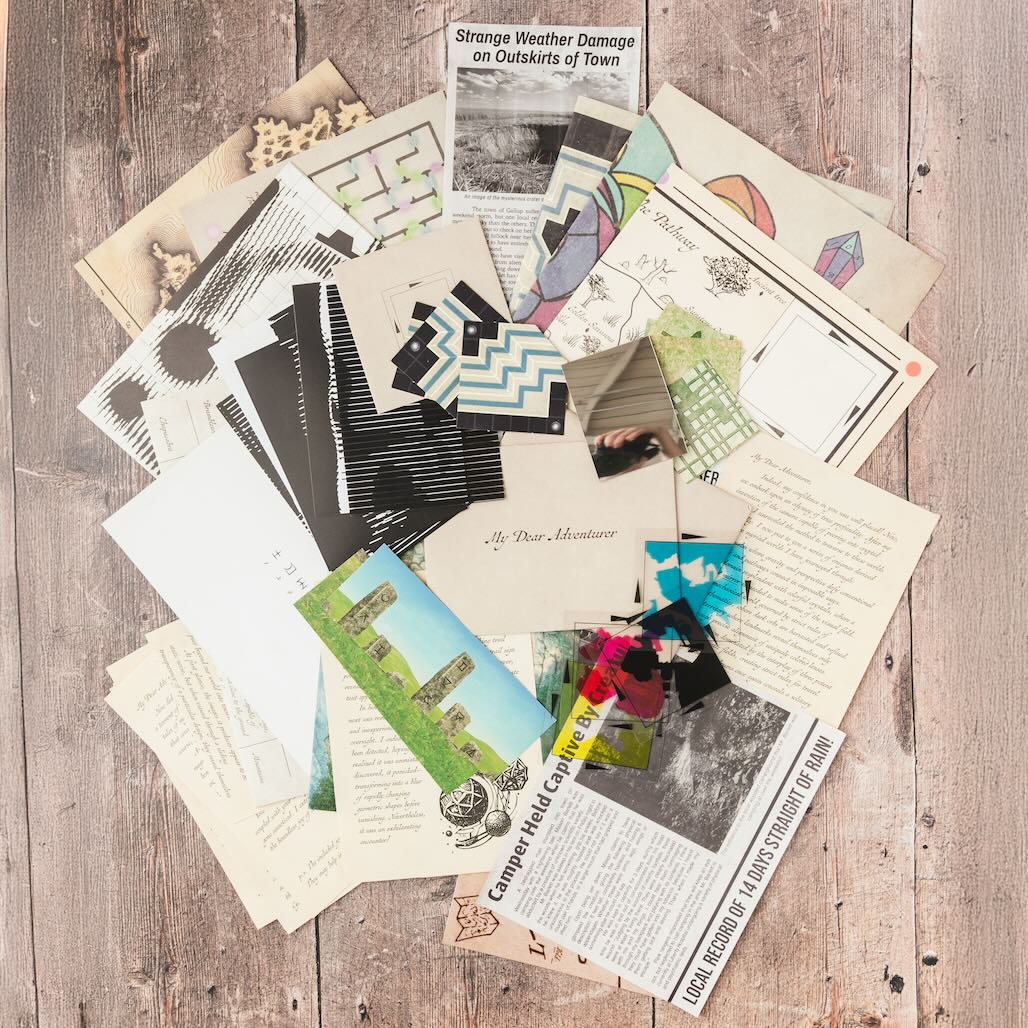
See what comes in the Down the Rabbit Hole box
If everyone is fourteen or older and would enjoy a wartime thriller, consider The Fifth Column. It plays with 1 to 6 people and takes 2 to 4+ hours across two parts. You’re in Manhattan in June 1945, working to stop a Nazi plot after Germany’s surrender. It has 4.9 stars from 152 reviews. You can compare other settings in our game collection.
To try the format first, choose a puzzle from our free Puzzle Archive. It holds fifteen browser puzzles with optional hints, graded from introductory to expert. If you’d prefer paper on the table, our free printable escape room puzzles guide is a separate place to start.
Setting up a game night people come back to
A little preparation helps, especially when everyone arrives tired or hungry.
Choose the game before people sit down and ask someone to read the rules in advance. Give a short explanation, then work through a practice turn if the game allows it.
Think about the surface, especially if you need the dining table back before a game is finished. Some board game table toppers provide a padded playing area with raised edges to contain pieces. Check whether a particular topper can safely move with a game on it; not all are designed for that. A spare table you can leave set up may be enough.
If you want a table topper, measure the playing area as well as the outside dimensions. Rails reduce the space available for the game. They can help contain dice and small pieces; for cards and paper, a simple mat may be enough.
Check how the topper folds or comes apart, where you’ll store it and whether a storage bag is included. It should be easy enough to put away that you’ll want to use it again.
Keep food off the playing surface, especially with paper clues. Put snacks on a side table and agree when to stop. You can always plan another round for a different evening.
Is a regular family game night worth the effort?
Agree on a date for the next game night while everyone is together. A regular evening can make planning easier, but choose a schedule that fits your family.
A shared game gives people something to work on together. There is room to explain an idea, notice something someone else missed and enjoy a result as a group.
Kathy A., a retired sixth-grade teacher, described playing Down the Rabbit Hole with her teenage grandsons: “When my husband and I drove them home after completing TWO packets we all laughed and laughed at my comments. We had an unforgettable time together and they couldn’t wait to come back the next day.”
Family game night questions we get asked
Here are a few questions to settle before you choose a game.
What is a good age to start family game night?
Start with a game designed for the child’s age and interests. Outfoxed! is rated 5+ and takes about 20 minutes; Rat-a-Tat Cat is rated 6+ and also has short rounds. Check reading and counting demands, then try a round together. Our own boxes start at 12+.
What should we play when the ages at the table are years apart?
Compare the reading demands and the different ways people can contribute. Outfoxed! is a cooperative choice for ages 5+, Sushi Go Party! uses simultaneous card choices for ages 8+, and Codenames puts players in teams for ages 10+. Read the specific game’s rules and choose the activity your group would enjoy.
Are escape room games good for family game night?
Yes, if the game matches the ages and interests at the table. Our boxes start at 12+ and most are rated 14+. Other publishers make escape games for younger children, so check the specific title rather than the format alone.
Do we need a board game table topper?
A topper may be useful if you want a different playing surface or edges to contain pieces. Check its size, storage needs and whether it can be moved with a game on it. If you can leave a game set up on a spare table, you may not need one.