The thing that decides what escape room team building costs for a remote team is not the sticker price of the activity. It is how you group people, because a hosted virtual room is priced per person per hour while a boxed game is priced once per box and shared by everyone around the table. The same thing decides whether any remote activity works at all: whether more than one person can be doing something at the same moment. A video call is a single channel, so one person talks and the other eleven listen. Any activity that also runs on one thread leaves most of the room watching. Below are seven online team building activities for remote employees, with what each asks of your budget and your own hours.

Why most virtual team building activities fall flat on a video call

We make at-home escape room games for a living, and rule five in our guide to designing escape room puzzles turns out to be the whole story here: a puzzle has to survive a group. Put a pure logic puzzle in front of six people and one of them sees it, says the answer out loud, and the other five have spent the evening watching someone think.

Put that same group on a video call and it gets worse. Only one person can hold the newspaper clipping. Only one person can talk without cutting across someone. The two quietest people go quiet in the first ten minutes and stay quiet for the rest of the hour. We work to a twenty-minute ceiling on how long a single puzzle should hold a solver before frustration turns into resentment, and on a call you get to watch that clock run down on nine faces at once. So the useful question about any remote activity is how many people are still actively doing something in minute eleven.

Seven online team building activities for remote employees

The time figure is roughly how many hours it takes one person to organize, which is the number these lists always leave out and usually the reason a good idea never happens. The billing column matters more than any headline price, because it is what makes the difference between twelve people and twelve invoices.

Activity How it is billed Hours of play Your time Everyone playing at once?
Shared puzzle in your team channel Free Minutes at a time, for months 5 minutes a week Yes
Lightning scavenger hunt Free 10 minutes 15 minutes Yes
Virtual trivia Free, or a one-off question pack 20 minutes 1 to 2 hours Yes, in breakout rooms
Virtual paint and sip Per head, plus a kit each, consumed One session Half a day Yes, mostly in silence
Online cooking class Per head, plus ingredients One session Two weeks of chasing Yes, and people talk
Hosted virtual escape room Per person, per hour 1 hour 20 minutes No, one person drives
At-home escape room game in pods Per box, shared by a pod, reusable 1.5 to 10+ hours, by title 1 hour plus shipping time Yes, if you use pods

1. A shared puzzle in your team channel

This is the cheapest thing here and the one we would start with. Somebody posts a cipher on Monday morning, people chip at it between meetings, and it gets cracked by Wednesday. It works across time zones, which almost nothing else on this list does, and it is genuinely parallel because everyone is looking at the same text at once.

Where it goes wrong: it dies the first week nobody posts. It needs one person who treats it as their job. The Puzzle Archive has fifteen of these sorted into four difficulty tiers, free and with no signup, which will get you through about three months. Ten of them are also free to print, one to a page, if you would rather attach a PDF than a link.

2. A lightning scavenger hunt

Everybody is off camera at once hunting for something blue, so it passes the parallelism test outright, and it is the best free option for a team that has never done any of this. The catch is that it lasts ten minutes and usually gets bolted onto the front of a meeting, so nobody remembers it a week later. It also quietly excludes anyone dialing in from a hotel room or a shared desk, who has nothing to go and fetch.

3. Virtual trivia

Trivia is reliable and low stakes, and it works as a warm-up before something longer. Split into breakout rooms of four or five and the whole team is talking at once.

Where it goes wrong: trivia rewards what people already know, so the same two colleagues win every round and everyone else has worked out by round three that they are scenery. Keep it to twenty minutes and pick categories nobody at your company has a professional advantage in.

4. A virtual paint and sip

Pick this for a team that is tired of competing at things. Nobody wins, which is the point, and it suits anyone who would rather not be scored on anything.

The problem is the supplies. You are shipping paint, brushes and a canvas to twelve addresses, the kits are bulky, and everything in them gets used up, so you buy it all again next time. Concentration and conversation compete, so expect long stretches of silence.

5. An online cooking class

This is the one people remember afterwards, because you eat at the end of it and food makes people talk. The cost is in coordination: ingredient lists, dietary restrictions, one broken oven and one person in a country where the recipe's cheese does not exist. Two weeks of back and forth is realistic.

6. A hosted virtual escape room

Its real strength is that it costs you one email and a calendar invite, and it scales to a headcount our boxes cannot touch. If you have eighty people and three weeks, book one.

Where it goes wrong depends on which format you book. In the avatar version, a facilitator walks around a physical room holding a camera and your team's job is to say "look left, open that drawer", so you spend an hour directing someone else's hands. In the browser version, everyone watches the same shared screen while one person drives the mouse. Either way the puzzles have to be solvable by strangers inside sixty minutes, which puts a hard ceiling on how interesting they are allowed to be.

The billing is the part to plan around. Hosted rooms are quoted per person for roughly an hour, with the rate stepping up as the group gets smaller and more staffed, so your bill scales with headcount and buys exactly one hour whatever you pay. Your own time is about twenty minutes.

7. An at-home escape room game played in pods

This is what we make, so weigh the recommendation accordingly. The reason it works is structural: the materials sit on a table, so four people can have four different pieces of paper in front of them and work separate strands at the same time. That solves the parallelism problem with physics instead of good intentions.

Where it goes wrong: buying one box per person and putting twelve people on one call, which reproduces every problem described above. Our game is a physical box that ships to one address, and that constraint is what makes the grouping decision the whole ballgame.

How to group a remote team of twelve, and why it changes the bill

One box covers up to six players, so the first thing to work out is not which game to buy but how many boxes you actually need. A team of twelve is two to four boxes. It is never twelve.

Three configurations, in order of how well they play:

Pods of three or four, three or four shipments. This is where the game is at its best. Everybody has material in front of them, nobody is waiting for a turn, and the pods finish close enough together to compare notes. It costs a little more per head than the largest pods and it is worth it.

Pods of six, two shipments. The cheapest per head, and two copies of a trilogy give twelve people 10+ hours across six parts, which you can spread over a year. We should argue against ourselves here, though: six around one box is the least parallel configuration on this page, and everything above says parallelism is what makes this work.

One box per household, twelve shipments. The most expensive route by a distance, because you pay twelve times and ship twelve times, and it still hits the single-channel problem if you then put everyone on one call. What you get is twelve people playing the same game separately and comparing notes afterwards, which is a book club with ciphers in it. That is a good thing to run, though it is not the shared solve people picture when they buy it.

The number worth taking to whoever holds the budget is cost per person-hour, and it is the one comparison that survives any price change on either side. A hosted room is billed per person and delivers one hour. A trilogy is billed once per box, is shared by a pod of up to six, and delivers 10+ hours across six parts, then passes to the next pod intact. Work that division out on the day you are buying and the gap is not close.

Current prices are on each product page, and shipping costs and free-shipping thresholds are on our shipping page and at checkout. The one thing worth checking before you split an order is whether consolidating two boxes into one shipment clears free shipping, because twelve separate small orders is the configuration that quietly costs the most.

See how The Blackbrim Trilogy splits into three sessions. It holds 4.9 stars from 533 reviews.

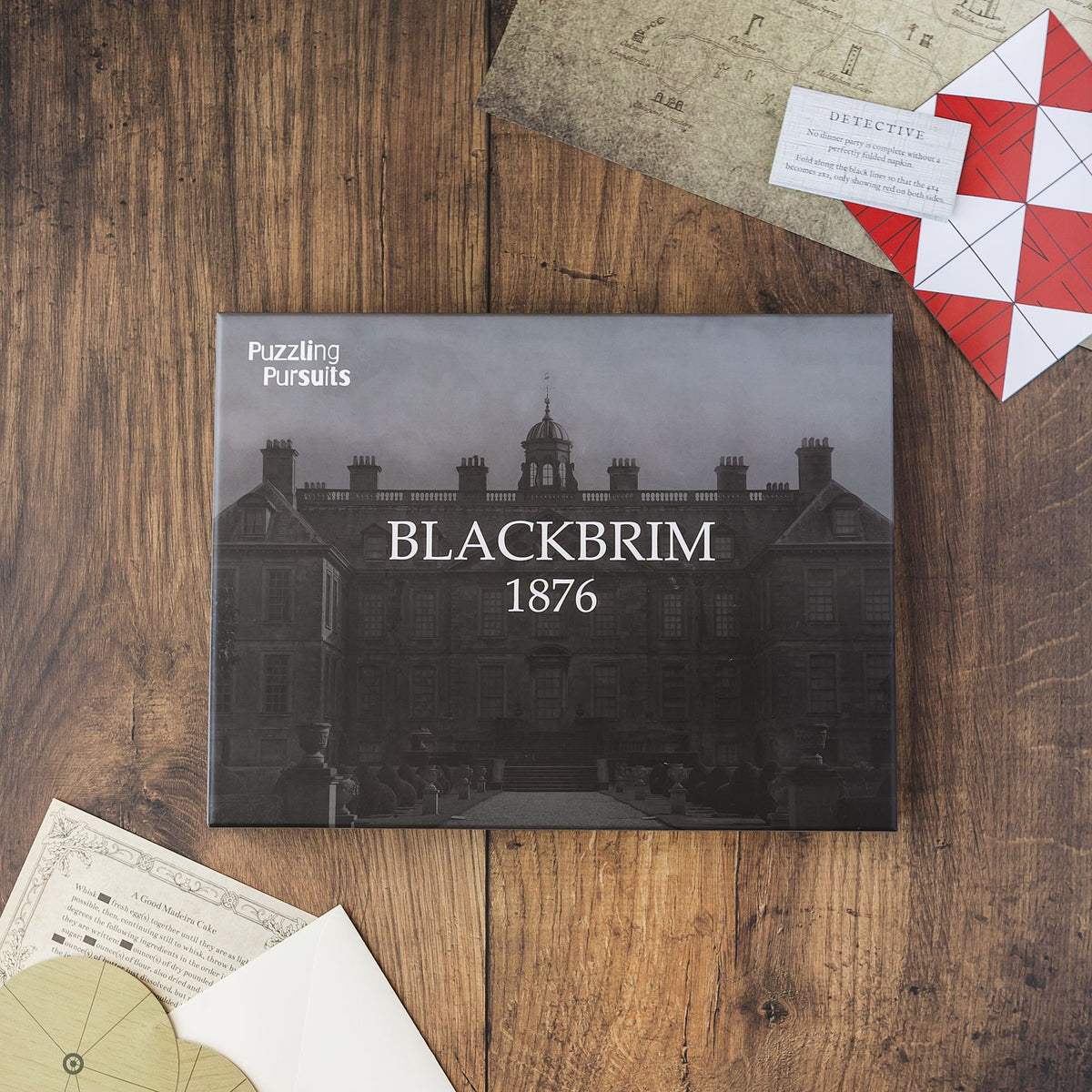
Components from Blackbrim: 1876, the first game in the Blackbrim Trilogy, spread on a dark wooden table: a wax-sealed envelope, handwritten letters, a Town of Blackbrim map, an architectural floor plan, a framed sepia portrait, printed cipher cards and wooden decoder discs

Buying for twenty people or more

Past twenty boxes the cart stops being the right tool, so we handle those orders by email at gifting@puzzlingpursuits.com, and there is more on our corporate team building page, which works through the per-head math for in-person and distributed teams. That is also where to ask about getting boxes out to a lot of separate addresses, which is the part of this that gets fiddly at scale. Email before you budget, because volume orders are not priced off the web store.

How to run an escape room game with a distributed team

Draw the map before you buy anything. Write down who can physically sit in a room with someone else: two colleagues in the same city, a regional office, anyone within an hour's drive. Those are your pods. One box covers up to six players, so a team of twelve is usually two to four boxes, never twelve.

Give every pod the same start time and one shared channel. Pods play at their own table and post progress as they go, which turns the video call from the venue into the scoreboard. Nobody has to sit and watch someone else think.

Most of our boxes hold two parts that resolve a single story, so you can run part one as the event and let pods finish part two whenever they like. Down the Rabbit Hole is the single-part exception and the one to pick if you have exactly one afternoon. There is no time limit on any of them, and the online companion guide holds the hints and the answer checks, so a stuck pod can unstick itself without waiting for you.

One more thing that matters at this budget: none of our puzzles require cutting or writing on the materials, so a finished box goes back in its sleeve intact and travels to the next pod. Three pods can share two boxes across a quarter if somebody is willing to mail them on. We would rather tell you that than sell you a third box.

Which at-home escape room games suit a work group

Not everything in our catalog belongs at a work event, so here is what we would actually put in front of a team.

The Blackbrim Trilogy is the pick for a pod that wants more than one evening. 4.9 stars from 533 reviews, 1 to 6 players, 10+ hours across six parts, ages 14+. Victorian England, working a manhunt for a criminal named Reager Skinner across three connected games.

The Fifth Column is our best-selling two-part game. 4.9 stars from 151 reviews, 1 to 6 players, 2 to 4+ hours, ages 14+. Manhattan, June 1945, and a plot that is still running after Germany's surrender. The tone is a wartime thriller and nothing grislier, which matters more at a work event than people expect it to.

Down the Rabbit Hole is the short one. 4.8 stars from 77 reviews, 1 to 6 players, 1.5 to 3+ hours, single part, ages 12+. Wonderland, and the lightest game in the catalog. Pick it when you have one afternoon and a group that has never tried this format.

Synapse is worth a look if your team builds software. 4.7 stars from 20 reviews, 1 to 6 players, 2 to 4+ hours in two parts, ages 14+. Players work their way into The Game, a secretive event run by a near-future AI company, and it lands differently on people who do this for a living.

What if part of your team shares an office?

Everything above assumes the team never shares a room. If they do, even once a quarter, an in-person event is easier to organize and better to be at, and we wrote a step-by-step guide to hosting an office murder mystery game night for exactly that case. Hybrid teams tend to get the most out of running something in person at the offsite and the pod version in the months between.

Remote team building questions we get asked

How many boxes does a remote team of twelve need?

Two to four, never twelve. One box covers up to six players, so twelve people is two pods of six at the cheapest, or three to four smaller pods if you want everybody actively solving rather than watching. Group people by who can physically sit in a room together, then buy one box per pod.

Can you play an at-home escape room game over Zoom?

You can, and it is the obvious thing to try, which is why we keep pointing at pods instead. One person ends up holding the materials and reading them aloud to everyone else. If a call really is the only option, give every household its own copy and run it as a race between households, not as one shared solve.

How many boxes does a team of twenty need?

Four, if you can group twenty people into fives. Our boxes are built for 1 to 6 players. Twenty boxes is what you buy when every person needs their own copy to keep, which makes it a gifting decision.

What if part of the team is outside the US?

We ship to Canada and the UK, and to Norway, Singapore and Australia, taking one to five weeks depending on the country, so order well ahead of the date. International rates are on our shipping page. Anywhere else, email support@puzzlingpursuits.com and we will work out whether we can reach them. Warn your international colleagues that they may owe a customs duty before the parcel is released, because a surprise bill on a gift lands badly.

Does everyone have to finish in one sitting?

No. None of our games run on a timer, and most boxes split into two parts, so a pod can stop at the end of part one and come back another week. The companion guide is there whenever they pick it up again.

Can we reuse a box with a second group?

Yes. No puzzle in any of our games needs cutting or writing on, so a played box passes to the next group intact. Ask the first pod to put everything back the way they found it, which is the only part of this that ever goes wrong.