Article: How to play escape room games at home
How to play escape room games at home
You can play an escape room at home with a boxed game, a digital game, a DIY setup, or a room hosted over video. Choose a box if you want the clues ready to open on the table. Choose DIY if you'd enjoy making the game for your guests. For people in different places, start with a format designed for online play.
Here's what each option involves, how much preparation it needs, and what to check before choosing.
The four options, compared
Compare the preparation as well as the playing time. Building the game can be a project in itself.
| Option | What you buy or make | What to prepare | What to check |
|---|---|---|---|
| Boxed escape room game | A copy for the people sharing its materials | Table space, the instructions, and any required device | Player count, playtime, hints, and whether you can pause |
| Print-at-home or digital game | A download or access to an online game; some are free | Printing for a paper game, or compatible devices for an online one | Whether it needs printing and supports players at separate addresses |
| Build your own | Puzzles, clues, and props you make for your guests | Time to plan, assemble, test, and host | Whether the clues work for someone seeing them for the first time |
| Live room hosted over video | A booked session with a host | The required video setup and a time everyone can join | Session length, group limits, and whether pricing is per person or per group |
Check whether the quoted price covers the whole group or each player, especially when booking a hosted event.
Boxed escape room games

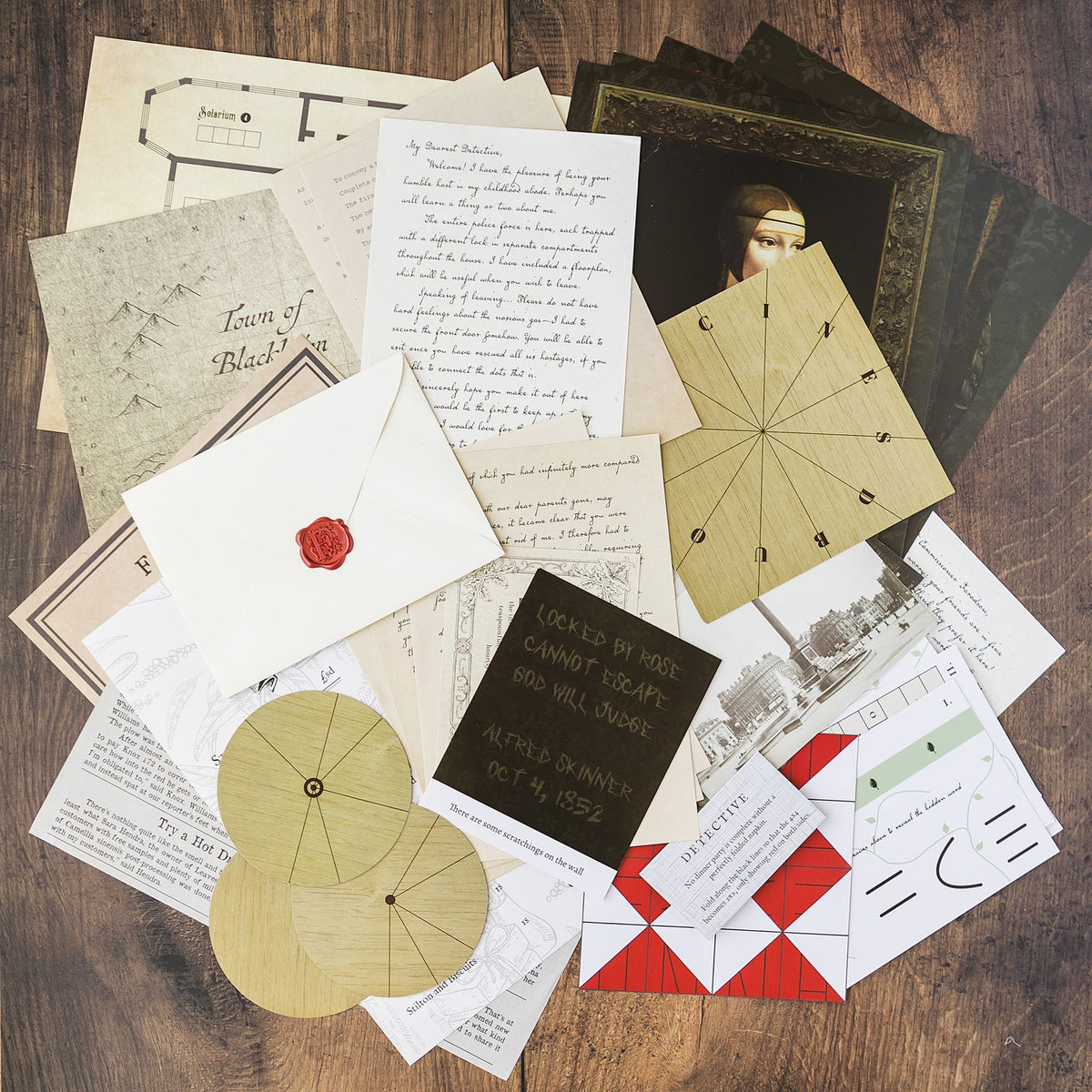
A boxed game gives you the story and clues to work through together. Depending on the game, you check answers against a printed key or an online guide, so everyone can solve without one person having to know the ending.
Playtime varies considerably between boxes. Check whether the estimate covers one complete game or a set of several games, and whether you can pause between parts.
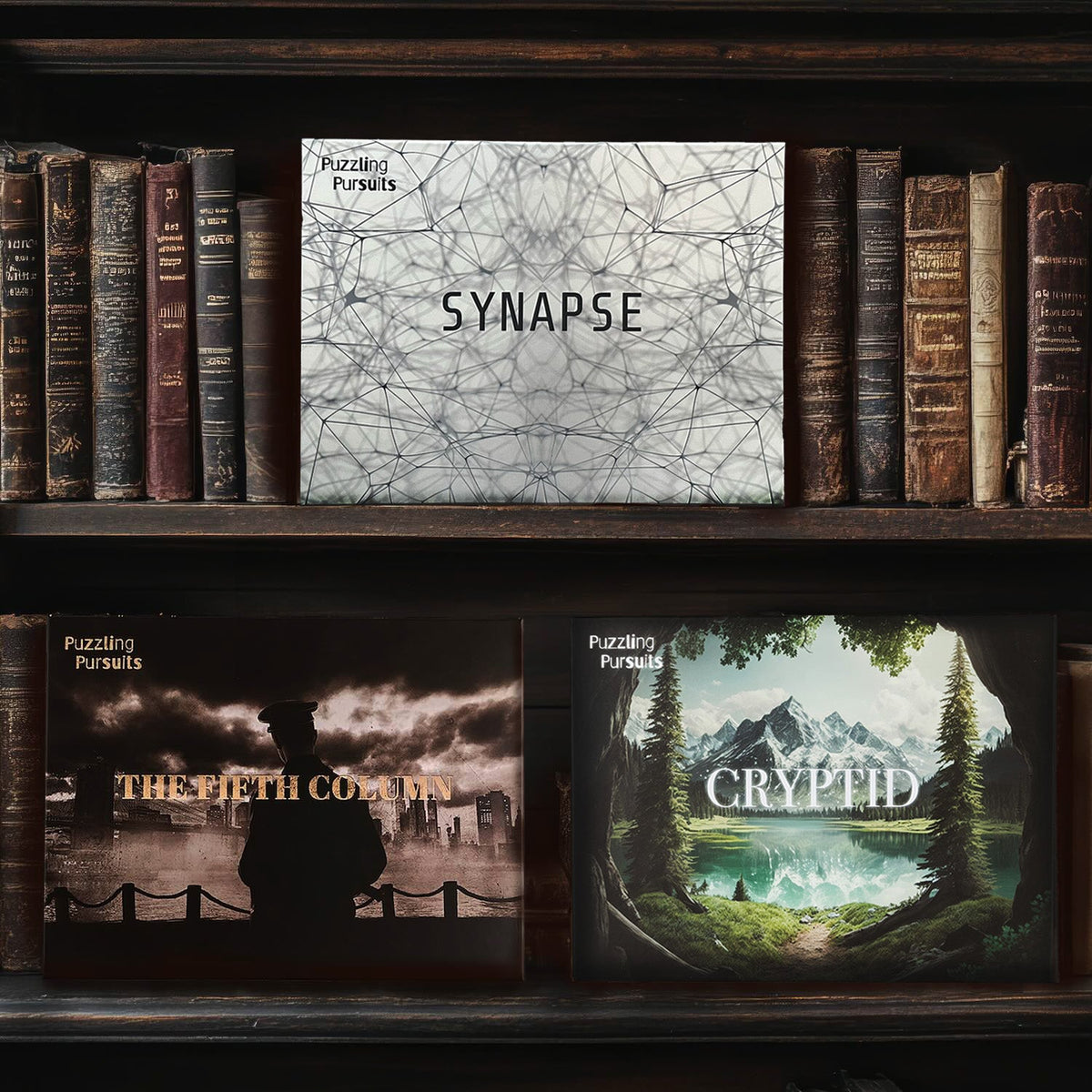
For specific titles, our mystery box game comparison covers eleven options, including Puzzling Pursuits and other publishers. It explains the kind of solving each offers and links to the details you'll need before ordering.
Choose the length that fits your evening
For a single evening, look at an individual case or escape game. Check the particular title's playtime and difficulty, and leave room for a slower solve if the format is new to you.
A longer box can work well over two sittings. Before you buy, check whether there's a natural stopping point and how you'll keep track of what you've solved.
A trilogy gives you several games in one continuing story. It's a useful choice if you already know you like the format, or you're planning more than one game night.
Can you pass the game on afterwards?
Check whether playing requires cutting, folding, or marking the materials.
Some games use their components up during play. The standard EXIT line, for example, includes cutting or marking materials. Check the instructions before starting if you hope to lend a game afterwards.
Our puzzles don't require you to destroy the materials. Keep notes on separate paper and put everything back carefully, and you can pass the box to another player when you've finished.

Blackbrim: 1876 gives you a Victorian case to work through, with a map and documents that reveal a criminal's trail. It takes 2 to 4+ hours across two parts for 1 to 6 players, ages 14+. It holds 4.8 stars from 524 reviews.
If you'd rather see the whole range first, everything we make is in our full collection.
Print-at-home and digital escape rooms
Digital games let you start without waiting for a parcel. Check the device requirements before buying; some need a laptop or desktop, and a game labeled “digital” may still need printing.
Try the free Puzzle Archive for a short introduction. It has fifteen puzzles with optional hints and answer checking in the browser. If you prefer paper, ten have printable versions.
Mission: Elfpossible is our digital Christmas adventure for 1 to 6 players, ages 14+, with 1.5 to 3+ hours of play. Use a laptop or desktop. Players can share one computer or play together remotely, and the starting email arrives within minutes of purchase.
Building your own escape room at home

Building your own lets you choose the story and tailor the puzzles to your guests. It also means you'll know the answers, so plan to host while they solve.
Allow time for planning and testing as well as making the props. Ask someone who hasn't seen the clues to try them, and leave time to revise anything that confuses them.
Our DIY escape room walkthrough covers themes, puzzle ideas, and a complete sequence you can make at home. The escape room puzzle design guide explains how to make clues clear and test whether the solutions make sense.
Live escape rooms hosted over video

In these, a staff member acts as your hands inside a real escape room while your group directs them over video. You see the room through their camera and tell them what to search and what to try.
Availability varies by venue, so check that the room is still offered online before planning an event around it. Ask how many players can join and what each person will be able to do.
Hosted rooms usually run for a booked session. Check the price basis, time limit, and minimum group size with the venue. A facilitator can help keep the event moving and handle questions as they arise.
What is the best at-home escape room game for adults?
Choose the setting and difficulty your group will enjoy, then check the player count and expected length. An adult age rating can reflect the story's subject matter as well as puzzle difficulty.
For a relaxed evening, a game you can pause is useful. If your group likes a challenge, check how the hints work: you may want to try a harder box while keeping help available.
A mix of shorter and more demanding puzzles gives the evening variety. When reading reviews, look for comments about pacing and hints as well as a general difficulty score.
For an adult table specifically, Blackbrim: 1876 or the full Blackbrim Trilogy at 10+ hours are the two we'd point you at, both for 1 to 6 players, ages 14+. The trilogy holds 4.9 stars from 533 reviews.
How to choose between the four
Use these questions to narrow the choice.
Is everyone in the same room? A shared table makes it easy to examine a boxed game's physical clues. For people at separate addresses, look for a digital game or hosted event designed for remote play. Check how each person will view and interact with the clues.
How long do you want it to last? Check the specific game's playtime and whether it has a timer. If you may need to stop partway through, look for a game that saves progress or has a clear break between parts. A hosted event needs to fit the booked session.
Do you want to solve, or to host? A ready-made game lets you discover the answers with everyone else. Building your own gives you the chance to write the story and tailor the clues, with you hosting while your guests solve.
How is an at-home escape room priced?
A boxed game is generally a single purchase for the people sharing that copy. Hosted events may charge per person or per group, so check the booking terms. A DIY game costs whatever you spend on materials and takes time to prepare.
How long does an at-home escape room take?
Playtime depends on the title. Check whether the estimate covers a single game or a bundle, and whether you can pause. Blackbrim: 1876 takes 2 to 4+ hours across two parts; the Blackbrim Trilogy contains three games with 10+ hours of play. For a hosted event, use the advertised session length.
Can you play an escape room at home by yourself?
Yes. Choose a game that explicitly supports one player and check how its hints work. Give yourself a flexible evening so you can follow your ideas without rushing. Our boxed games support solo play and include an online guide with optional hints.
Do you need locks and props for an escape room at home?
No. Locks are one way to gate progress, and an answer checked against a printed key or a companion guide does the same job. What matters is that the answer proves itself when you get it right.
Are at-home escape room games reusable?
It depends on the game. Some require altering the components, while others can be reset for new players. Our puzzles don't require destructive changes, so you can pass a box on if you keep the materials in good condition.
Where to start
Start with a ready-made game if you want to spend the evening solving. Choose DIY if you would enjoy creating a story and hosting it for your guests. A short free puzzle is a useful way to try a few puzzle mechanics before deciding.
For specific comparisons, see our guides to games like Hunt A Killer and games like Box One. If you're choosing a present, our escape room gift guide covers what to check about the recipient and delivery.
For your first box, Down The Rabbit Hole is our introductory Wonderland adventure. It takes 1.5 to 3+ hours for 1 to 6 players, ages 12+, and holds 4.9 stars from 82 reviews. Choose Blackbrim: 1876 if the Victorian detective case sounds more like your evening.