How to organize an office murder mystery game night
To organize an office murder mystery game night, first choose between a character party and a cooperative puzzle game. Then confirm attendance, divide the group into tables and choose a game that fits your time slot. Leave room for arrivals and the explanation of the rules. The most useful preparation is making sure everyone will have something to do, including colleagues who would rather solve than act.
This guide covers both formats, with extra attention to sharing clues and helping a table that gets stuck. Our own boxed games are one option for the cooperative format.
Choosing a theme and planning your office murder mystery game night
Choose a theme your colleagues can understand quickly. A speakeasy or country-house mystery gives a character party a clear setting. If you’re choosing a cooperative game, the theme matters more as a shared interest than as a costume assignment.
A setting away from office life can help people relax. Our murder mystery theme guide compares ten options and explains what each needs from the host.
Before sending invitations, confirm how long the game takes and whether you can rearrange the room into small tables. Include arrival time in the schedule and say clearly whether attendance and costumes are optional.
Match the game to the headcount. Our boxes play with 1 to 6 people, so a team of twenty-four can use four boxes at four tables. A scripted party kit works differently: its character count determines how many people can play.
Selecting characters and assigning roles
Use confirmed attendance when choosing a scripted kit, and check whether it allows extra or optional characters. Leave room for late changes without assigning a role the kit can’t support.
Ask which guests want speaking roles before assigning characters. Send a brief explanation of what participation involves, especially if a role calls for a speech or a dramatic reveal.
Send character notes at least a day ahead. A short brief is easier to use than pages of backstory, especially for someone who reads it just before the event.
Offer optional jobs such as writing discoveries on a whiteboard or keeping the documents organized. For a fixed-cast party kit, use only the roles it supports; do not add story characters that change the mystery. Colleagues who prefer solving can contribute without taking a speaking role when the format allows it.
Creating clues and puzzles that keep the whole room busy
For a homemade game, these principles from our escape room puzzle design guide will help you share the work across the group.
Give the table more than one thing to work on. A single sheet can easily end up in one person’s hands while everyone else waits. Separate clue materials let people examine different pieces and bring their findings back to the group.
Split useful information across several documents. For example, one person might have a coded message while another finds its key. Each player should have a reason to share what they found.
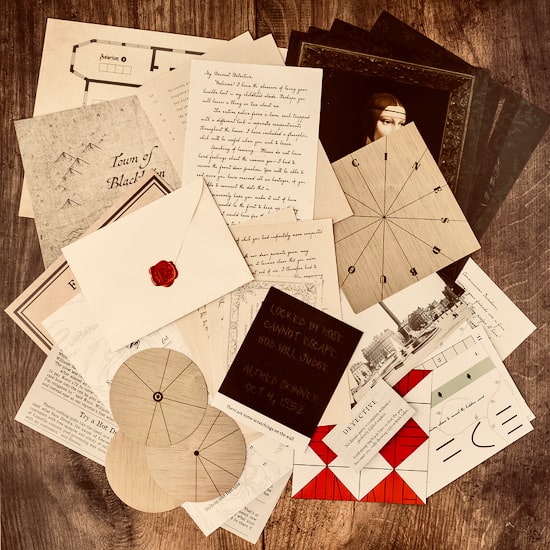
The separate materials in a box can be shared around the table so players have different clues to examine.
Supply every piece of information the puzzle needs, either in the room or through a clearly signposted online resource. Do not assume everyone knows a colleague’s history or where a department sits. If that detail matters to the answer, include it in the clues.
If players must search for a clue, give them a fair reason to look in that place. A hiding puzzle can be fun; an unmarked envelope that nobody knows to search for can simply stop the game. Check that all materials will remain where you leave them until the event.
Make the task clear enough to begin. A visible four-digit lock, for example, tells players the answer format they need. They can still have to work out how the clues produce those digits.
Prepare hints for clues that might hold a table up. If a group makes no progress for a while, offer a nudge and let them decide whether to take it. Mix quick solves with more demanding puzzles so the evening has some changes of pace.
Ask someone who won’t be playing at the event to try the clues first. Watch what they understand without explanation. If you have to fill in a missing instruction, add it to the materials before the night.
For a homemade puzzle, prepare a gentle hint, a more direct explanation and the answer. That gives the host several ways to help without revealing more than the group wants. For a purchased game, use its included hint system.
If that list reads as more work than you were expecting to take on, there is a section further down on buying a box instead.
Decorations and props for an office murder mystery party
Arrange the room so each small group can see and handle its clues. Then choose lighting that sets the mood while keeping documents readable. A few themed objects are enough if you would rather spend preparation time on the game.
A prop’s shape can suggest what to do with it. A marked fold line can invite folding, and a wheel mounted at its center can invite turning. Try the prop with someone unfamiliar with the puzzle to see whether it needs an instruction or another clue.
For a speakeasy theme, a few period-style objects can give the table a setting. Check the building’s rules before using candles or attaching decorations to walls and windows.
Food and drinks that survive a game night
Choose snacks people can eat between puzzles and serve them on a separate table. Plan around dietary requirements and the food’s serving instructions, especially if it needs to stay chilled or hot.
Use a separate surface for food and drinks so spills are less likely to damage clues. Leave somewhere nearby for people to put a glass while they handle the materials.
Decide whether food and drinks come before the game or stay available during it. If you’ve chosen demanding puzzles, leave time to eat first so people can give the clues their attention.
Put out non-alcoholic options people would enjoy, and find out about dietary requirements before the day rather than at the door. This is a work event, so the ordinary rules about not making people announce their restrictions in front of colleagues apply.
Should you write your own or buy a boxed game?
Writing a game means planning the story, making the clues and testing them with someone who has not seen the answers. The time depends on its length and complexity. Choose that route if you enjoy creating puzzles and have time to revise them after a trial run.
If you want everyone to play a character, buy a scripted murder mystery kit. Night of Mystery’s hosting guide is a useful starting point. Follow the kit’s timing and hint instructions rather than adding a different structure on top.
Our at-home escape room games give a table of up to six people printed materials to work through together. Answers and hints are in an online companion guide. Nobody needs to act or improvise, which suits a group that would rather solve clues than perform.
Three of ours suit a work crowd:
- Blackbrim: 1876 makes the group a team of private detectives following Reager Skinner’s trail. It takes 2 to 4+ hours across two parts for 1 to 6 players, ages 14+, and has 4.8 stars from 524 reviews.
- The Fifth Column is set in Manhattan in June 1945. The group works to stop a Nazi plot after Germany’s surrender. It takes 2 to 4+ hours across two parts for 1 to 6 players, ages 14+, and has 4.9 stars from 152 reviews.
- La Famiglia takes the group to Chicago in 1929 to help the FBI bring down a mafia organization. It takes 2 to 4+ hours across two parts for 1 to 6 players, ages 14+, and has 4.8 stars from 99 reviews.
Nothing in our boxed puzzles requires cutting or writing on the materials. Keep the pieces together and return them to their original sections, and another team can play the box later.
For an event, allow one box per table of up to six: twenty-four players need four boxes. Our corporate gifting page covers orders of twenty games or more. For those larger orders, email gifting@puzzlingpursuits.com with the quantities and date so we can discuss shipping.
The clues played to different family members' strengths, giving everyone the feeling of participating.
Brian W., verified review of Blackbrim: 1876
Before the event
Run through these details before people arrive:
- Send the details and the expectations well ahead, including how long it will run and whether costumes are optional. People plan their evening around your answer.
- Explain the rules at the start and show everyone how to request a hint, even if you sent those details in advance.
- For a homemade or scripted game that needs a host, choose someone to keep the answers and watch the schedule. Our cooperative boxes use an online guide, so a separate non-playing game master is optional.
- Offer practical jobs such as sorting documents or writing down discoveries. Let people choose how they contribute.
- Have an option ready for tables that finish early. Our free Puzzle Archive has fifteen browser puzzles with optional hints. The separate free printable puzzles guide is useful if you’d prefer paper.
- Ask people whether they are comfortable being photographed before taking or sharing pictures of the event.
If part of your team never makes it into the office, the planning is different enough to need its own guide. We wrote one on escape room team building for remote teams, including what a boxed game really involves once you are shipping to a dozen separate addresses.
If the game night is part of your holiday plans, our guide to holiday gifts for clients can help with the gift list too.
Common questions
These questions help match the format to your office and schedule.
How long does an office murder mystery game night take?
Choose a game whose published playtime fits the event, then add time for arrivals and rules. Our two-part boxes take 2 to 4+ hours in total. If the event is shorter, plan to stop between parts and arrange a way for people to continue later.
How many people do you need for an office murder mystery?
Check the player count on the game you choose. Our boxes play with 1 to 6 people; a scripted party kit has a specific cast size. For a larger cooperative event, use several small tables with one copy of the game per table.
What if some of my team do not want to act?
Choose a cooperative format if people would rather solve than act. For a scripted party, ask who wants a speaking role and check whether the kit offers useful optional roles. Make the expectations clear before people agree to attend.
Can you run a murder mystery night in a normal office?
Yes. Arrange small tables to match the game’s player count, with enough room and light to read the materials. Check your building’s rules before planning candles or decorations that attach to walls.
Is it better to write your own or buy one?
Write your own if you want to create the story and have time to make, test and revise its clues. A purchased game provides that work for you. Use its included hint system; for a homemade game, prepare hints at several levels so the host can give only as much help as players want.
How many boxes do we need for the team?
Allow one box per table of up to six players. A team of twenty-four can use four boxes at four tables. Each table needs its own materials and access to the online guide. Add time for arrivals and explaining the rules when planning the event.